

👉This week, we’re talking about: how anthocyanins and anthocyanidins cross the blood-brain barrier to improve cognition; rhubarb and a good source of anthocyanins and anthocyanidins; letting joy be your metric for healthified desserts; my full collection of tips for enjoying quality-of-life foods (like dessert!) in moderation; and my recipe for Gluten-Free Rhubarb Coffee Cake.1
Key Takeaways
✅Anthocyanins and anthocyanidins give blue and purple fruits and vegetables their distinctive colors, and among their many benefits is improved cognition!
✅Rhubarb gets its pretty pink-violet hue from anthocyanins and anthocyanidins, and its delicious in my Rhubarb Coffee Cake recipe!
✅Enjoying treats in moderation in a skill that takes practice, and I have my full list of strategies for you below!
✅For paid subscribers, your downloads this week are: Gluten-Free Rhubarb Coffee Cake and Phytonutrients in Blue and Purple Foods
Anthocyanins and Anthocyanidins for Learning and Memory
🧬Anthocyanins and anthocyanidins are a class of flavonoid polyphenols that give many fruits and vegetables a beautiful blue, purple, violet, or deep red color (think: grapes, red cabbage, cherries, eggplant, rhubarb, blueberries, cranberries, raspberries, and blackberries!). You also get anthocyanins and anthocyanidins from some legumes, like black beans, and some grains, like black rice!
Anthocyanins and anthocyanidins are uniquely and specifically capable of both crossing the blood-brain barrier and localizing in areas of the brain involved in learning and memory (e.g. hippocampus). In addition, they have powerful anti-oxidant and anti-inflammatory properties, which is important since oxidative stress and inflammation are thought to be key contributors to cognitive impairment.
A variety of studies have shown that anthocyanin- and anthocyanidin-rich extracts from foods such as from berries, pomegranate or rhubarb, improve memory, especially working memory, attention and cognitive performance, especially executive function, in both young, healthy adults and older adults at risk for cognitive decline.
Want to know the top 25 best food sources of polyphenols? Learn them here.
Get 325mg of Polyphenols with Rhubarb
Rhubarb gets its beautiful deep red color from anthocyanins and anthocyanidins! Botanically, rhubarb is a vegetable but is prepared and consumed as a fruit from a culinary perspective, which is a bit of a rarity. In addition to being high in polyphenols, per serving (1 cup, diced, or a little less than 2½ stalks), rhubarb provides 30% DV vitamin K, 11% DV vitamin C, and 10% DV manganese. All that and it’s only 26 calories per cup! Hence rhubarb’s impressive Nutrivore Score of 598!
Rhubarb is the 217th most nutrient-dense food! Learn the Top 500 Nutrivore Foods here.
Gluten-Free Rhubarb Coffee Cake
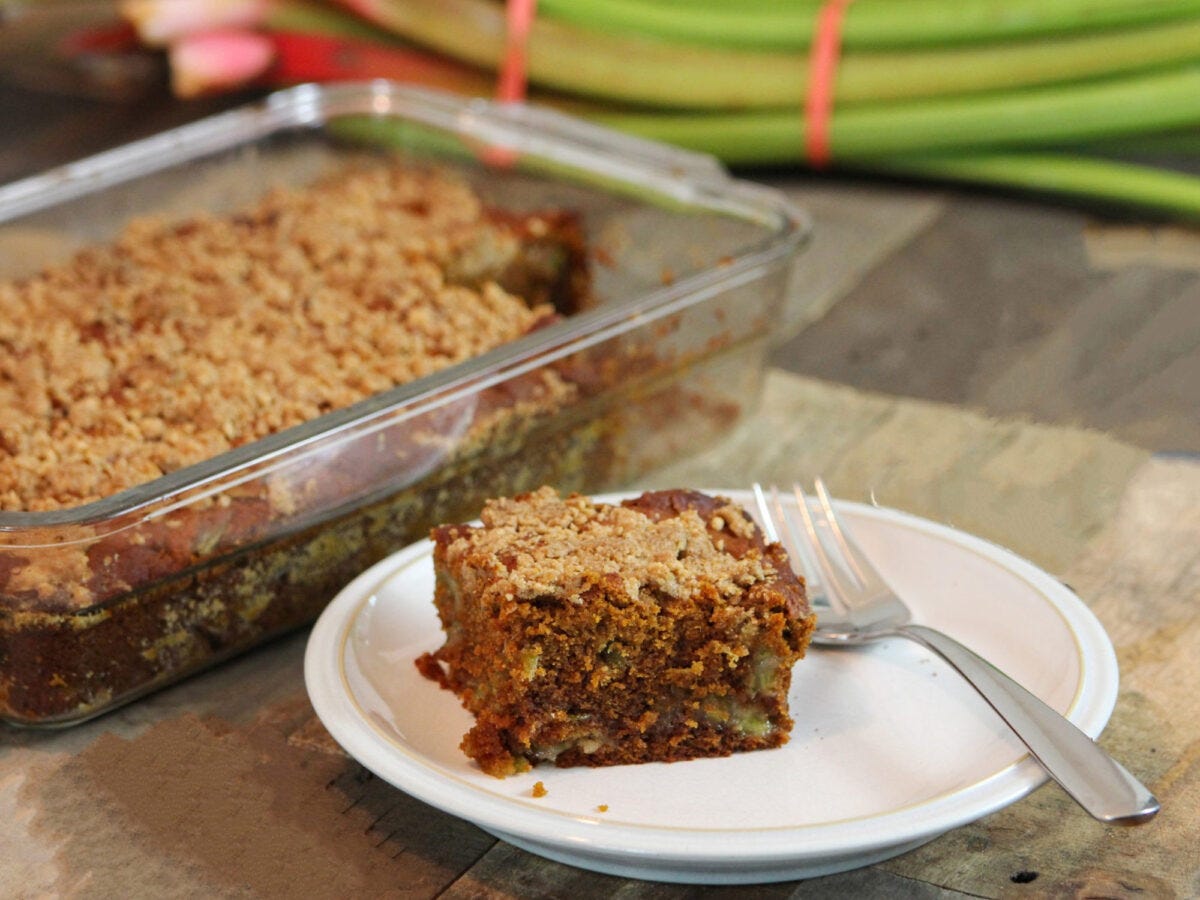
🥗 This is a gluten-free adaptation of a family recipe that dates back to my great-great-grandmother, who was “Nana” to her grandchildren, great-grandchildren, and great-great-grandchildren and something of a legend in my family as she was a formidable, caring and selfless woman. As a kid, this coffee cake was the go-to to serve company, especially in the early spring when we could pick rhubarb fresh from the garden.
Add this recipe to your meal plan this week with Real Plans, the official Nutrivore meal planning app!
Nutrivore Mindset Corner
🧠Here’s my philosophy on healthified desserts—like black-bean brownies, cottage cheese ice cream, and chickpea cookie dough—if swapping out an ingredient for a more nutrient-dense alternative or sneaking in some hidden protein powder or beans, doesn’t take away from my enjoyment of the sweet treat, then I’m all in. For me, it doesn’t have to taste the same as the regular version of the treat, but it does have to provide the same level of joy. And if it does, of course I’m happy to benefit from more nutrients, less sugar or lower energy density, and a healthier fat profile. BUT, if the healthified dessert in question sacrifices flavor or texture, I know that eating it will leave me less satisfied and more likely to compensate by eating more or seeking out a different treat later on.
For me personally, it’s usually better to choose the non-healthified dessert option, give myself full permission to enjoy it, and use my strategies for moderation, including: enjoying the treat mindfully and without distractions; and enjoying the treat after a balanced, nutrient-dense, and delicious meal. I believe joy is also an essential nutrient, and that choosing some foods for deliciousness (and not nutrition) helps ensure we’re enjoying our overall healthy eating patterns enough that we can stick to them long term.
Now, for me, I get more joy out of a small portion of conventional ice cream than I get from the giant bowl of low-calorie, protein ice cream. But, I recognize that for many people, it’s the opposite—being able to eat that bigger volume of a healthified dessert is what ups the joy. And if that’s you, that’s okay, and why I framed my personal decision making in terms of joy. If opting for the healthified dessert is what helps you adopt overall healthy eating patters, that’s awesome! If option for the conventional dessert works better for you, that’s awesome!
Learn everything you need to know about the Nutrivore philosophy in my book, Nutrivore: Eat Any Food, Get Every Nutrient, and Transform Your Health!
Helpful Tip of the Week
💡Since I just talked about enjoying treats in moderation, I figured I should share my full collection of strategies for doing so! These tips are designed to help you learn (or re-learn) how to enjoy quality-of-life foods in a way that feels balanced, satisfying, and sustainable. Note, this is a skill—and like any skill, it takes practice.
Give yourself unconditional permission to eat them. When you remove the mental restriction, food loses its power to control your thoughts. This defuses the “forbidden fruit” effect and helps normalize foods that once felt off-limits. It’s completely normal to overdo foods you previously restricted—that’s a part of the process. As you rebuild trust with yourself and your body, the intensity and novelty typically wear off. (If it doesn’t, see the tip below on asking for help.)
Slow down and savor. Take the time to really taste and enjoy your treat, paying attention to flavor, texture, and satisfaction. Try to eat without distractions—like watching TV or scrolling your phone—so your brain fully registers the experience. You may find you’re satisfied with less, and you’ll enjoy it more.
Prepare your nutrient-dense foundation foods in ways you enjoy. Experiment with seasonings, cooking methods, and flavor combinations that make your meals genuinely satisfying. When your everyday meals are crave-worthy, you won’t rely on treats alone for pleasure—your quality-of-life foods become part of a delicious, well-rounded menu instead of the main event.
Pair them with nutrient-dense meals. Enjoying a treat after a satisfying, nutrient-rich meal helps you feel physically full and emotionally content. For example, a few cookies after a colorful, balanced lunch can feel like a bonus—not a binge. When your nutritional needs are met, and nutrient-dense foods are prepared in ways you enjoy, it’s easier to enjoy quality-of-life foods without guilt or overindulgence.
Eat big enough meals. Make sure your meals are satisfying and balanced (and don’t skip them!) so you’re not overly hungry or feeling deprived when a treat comes along. When your body feels nourished and full, it’s easier to enjoy quality-of-life foods in moderation, without turning them into a meal replacement or eating past fullness. If you’re contemplating a treat between meals, pair it with a nutritious snack that includes some protein and fiber (like apple slices and peanut butter, or veggie sticks and hummus).
Buy single servings or portion ahead. Choosing individual portions of treats—or portioning them out yourself—can make it easier to enjoy them mindfully, without accidentally slipping into autopilot eating. This removes the decision-making burden in the moment and helps you feel more in control and satisfied with what you’ve planned.
Let go of guilt. One treat doesn’t undo your progress—in fact, it’s part of what makes your progress sustainable. Guilt adds stress and undermines your ability to make nourishing choices. Enjoying food with confidence and self-compassion helps reinforce a positive, long-term relationship with eating.
Regulate appetite and cravings with a healthy lifestyle. Consistent sleep, regular movement, and daily stress management are key players when it comes to regulating appetite and cravings. If you find yourself reaching for snacks late at night, consider whether you’re truly hungry or just trying to stay awake—sometimes the best thing you can do is simply head to bed. Gentle, regular physical activity (like a walk or stretching) can also help reduce cravings and stabilize hunger signals throughout the day. These simple habits support your body’s natural rhythms and make it easier to stay balanced without relying on willpower alone.
Don’t skip breakfast. Eating a balanced breakfast within two hours of waking helps set the tone for the entire day. It supports stable blood sugar, reduces stress hormone fluctuations, and helps regulate appetite and cravings later on—making it easier to stay grounded in your healthy habits and avoid impulsive food decisions.
Plan it, instead of being impulsive. Craving chocolate cake? Instead of trying to resist all day and then giving in when your willpower wears thin, decide ahead of time when and how you’ll enjoy it. Planning a treat—for example, a slice of cake after a satisfying dinner—can help you stay present, eat more mindfully, and avoid feelings of guilt or loss of control.
Ask for help if you need it. If you’re really struggling with a permissive mindset—or if you notice that food guilt, anxiety, or past disordered eating patterns are interfering with your progress—please reach out to a qualified support professional. An eating disorders specialist, intuitive eating coach, or anti-diet registered dietitian can provide personalized guidance, validation, and strategies that help you rebuild your relationship with food in a safe and sustainable way.
A permissive mindset isn’t about giving up on health goals. It’s about creating space for real life inside your healthy habits. And that’s what makes Nutrivore sustainable.
Watch & Learn
🎥Check out my YouTube videos on what foods count as protein and FAQ about the Nutrivore Meal Map! And don’t forget to subscribe and hit bell notifications, so you never miss a new video!
This Week’s Downloads
📥For paid subscribers, your downloads this week are:
Phytonutrients in Blue and Purple Foods. - This 1-pager PDF guide summarizes the phytonutrients that give blue and purple fruits, vegetables, and legumes their distinctive colors and health benefits.
Gluten-Free Rhubarb Coffee Cake - A beautifully-designed PDF version of this week’s recipe that you can save or print out, to build your own personalized Nutrivore Cookbook week by week.
You can find buttons to download at the bottom of this Substack. Thank you so much for supporting my work and Nutrivore!
Sincerely,
Dr. Sarah Ballantyne, PhD
Founder of Nutrivore
Medical Disclaimer: The information provided in this Substack is for educational purposes only and is not intended as a substitute for professional medical advice, diagnosis, or treatment. Always seek the advice of your physician or another qualified healthcare provider with any questions you may have regarding a medical condition or dietary changes.
FTC Disclosure: Some links in this Substack may be affiliate links, meaning I may earn a small commission if you purchase through them at no additional cost to you. I only recommend products I genuinely believe in. Thank you for supporting my work!
