

👉This week, we’re talking about: the link between resistant starch and gut health, plantain as an awesome source of resistant starch, how bananas and plantains compare, my tips for nourishing yourself during busy seasons, and I’m sharing my favorite side dish of Cinnamon Butternut Squash and Plantain with Apple recipe.1
Key Takeaways
✅Resistant starch is an important fiber type for a healthy gut microbiome.
✅Green plantains are rich in RS2 type resistant starch, plus lots of vitamins and minerals.
✅Bananas and plantains are cultivars of the same plant! I explain the difference below.
✅For paid subscribers, your downloads this week are: Holiday Recipe Booklet (which includes 5 cookie recipes!) and Cinnamon Butternut Squash and Plantain with Apple
Resistant Starch for Gut Health
🧬Resistant starch is a type of highly-fermentable insoluble fiber that isn’t fully broken down in your small intestine. It “resists” the action of your digestive enzymes because of its molecular structure; and instead, it becomes food for super important probiotic strains of bacteria in your colon.
Sources of resistant starch include grains, legumes, and seeds for RS1; green bananas, green plantains, and raw potato starch for RS2; cooked and cooled potatoes, rice and plantains for RS3; and enzymatically or chemically modified starches sold under various brand names for RS4.
Want to know the top 25 best food sources of fiber? Learn them here.
Green Plantains for Resistant Starch
🍌Unripe (green) plantains are also high in the RS2 form of resistant starch. (As plantains ripen, their resistant starch content decreases while their sugar content increases.) Plus, plantains are rich in polyphenols, vitamin K, vitamin C, vitamin B7 (biotin), copper, vitamin B5, carotenoids, magnesium, and potassium.
As you could probably guess, plantains are a close cousin of the banana; they share the same genus, Musa. Unlike bananas, plantains are almost always eaten cooked (in fact, they’re sometimes called “cooking bananas”), and they are usually large, more angular, and contain much more starch in comparison to sugar. They originated in Southeast Asia. And while they’re most commonly eaten as food, in some parts of East Africa, they’re also an important crop for making beer! Worldwide, plantains are much more common than the sweet “dessert” bananas common in the United States and Europe.
While there are some differences in the sugar content of green or yellow plantains, the small nutritional differences don’t make that much of a change to the Nutrivore Score:
Green plantain, raw 173
Yellow plantain, raw 186
And the different ways to prepare green plantain also only make slight changes to the nutrition profile. Any way you choose to eat them, green/yellow/cooked or otherwise, plantains are a great nutri-licious choice.
Green plantain, boiled 173
Green plantain, fried 152
Green plantain, raw 173
Plantain is the 432nd most nutrient-dense food! Learn the Top 500 Nutrivore Foods here.
Cinnamon Butternut Squash and Plantain with Apple
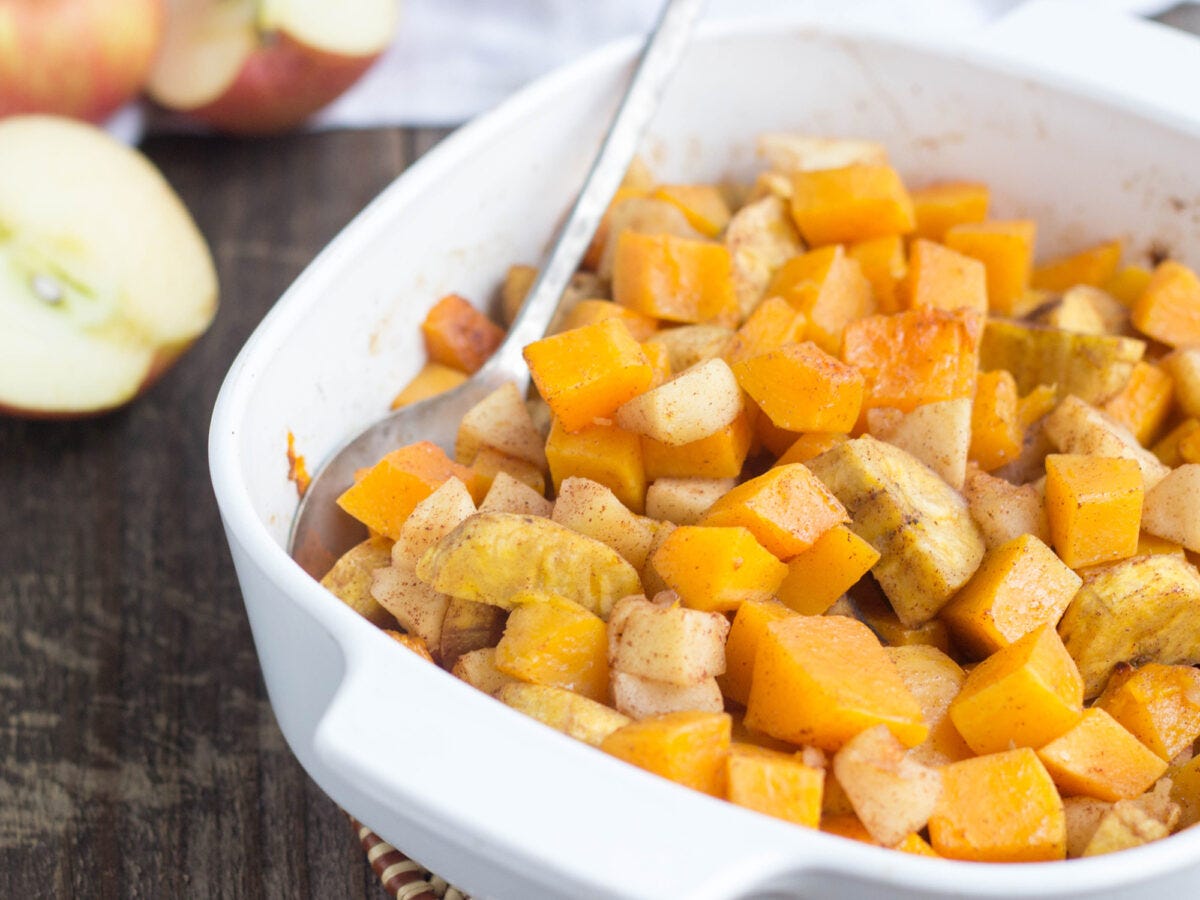
🥗 Plantains pair beautifully with starchy root veggies, like this delightful combination of baked apple, plantain, butternut squash, and cinnamon. I think this is the perfect side dish with pork, but it also works well with chicken or turkey. You can use green or yellow plantains for this recipe.
Add this recipe to your meal plan this week with Real Plans, the official Nutrivore meal planning app!
Nutrivore Mindset Corner
🧠Let’s talk about nourishing yourself during busy seasons. These times of year (or life) make it easy to slip into all-or-nothing thinking: if I can’t maintain that perfect eating streak, I might as well give up and worry about getting “back on track” later. I think it’s important to give ourselves grace during stressful or hectic times, and honor the calming effects of comfort foods. At the same time, our bodies still need steady, supportive nutrition—often even more so when we’re stressed and strained.
Instead of striving for ideal meals, try anchoring your day with simple nutrient dense moments—a piece of fruit, a handful of nuts, a colorful veggie, a balanced plate when you can manage it. When leaning on comfort foods, think about easy additions to add more nutrition—a side salad or veggie sticks, steam-in-the-bag frozen veggies, a bit more protein like some beans or chicken. These small nutrient boosts keep your energy steadier, your mind clearer, and your body more resilient.
And don’t be afraid to keep things super simple. Some of my go to quick meals for busy days:
A rotisserie chicken and a salad kit
Mac & cheese made with bean based pasta and with frozen broccoli or peas added
Scrambled eggs or an omelet with whatever veggies are on hand and with fruit and multigrain toast on the side
Soup and sandwich, I particularly like pairing a veggie-rich soup (canned is fine!) with a tuna-salad or salmon-salad sandwich
A microwave able baked potato topped with beans, salsa, and a sprinkle of cheese
Remember that it’s your overall eating patterns—not any single meal—that shape your long-term health. Giving yourself permission to make simple, time-saving swaps isn’t a setback; it’s a supportive way to care for yourself during demanding seasons.
Learn everything you need to know about the Nutrivore philosophy in my book, Nutrivore: Eat Any Food, Get Every Nutrient, and Transform Your Health!
Helpful Tip of the Week
💡Let’s talk bananas versus plantains. They are both members of the genus Musa, growing on plants that are technically giant herbs rather than trees, since they have a “pseudostem” made of tightly packed sheaths, rather than a true, woody trunk! In general, bananas refer to cultivars that are eaten when fully ripe and sweet, while plantains refer to larger, starchier, lower-sugar cultivars that are eaten cooked (though they can be eaten at any stage of ripeness).
One last cool fact – ripe bananas and banana plant leaves fluoresce when exposed to ultraviolet light, while green or unripe bananas do not.
Yellow plantains are higher in sugar than their green counterparts because as the plantain ripens, starches within the fruit are converted to sugar. These plantains are mid-way through the ripening process; if left to fully mature, plantains will turn completely black. Yellow plantains are sweet and can be eaten raw but are not as flavorful as bananas so are usually consumed cooked. Often they are enjoyed fried, where the sugars caramelize turning them into a tasty treat.
Watch & Learn
🎥Check out my YouTube videos on letting go of food rules and carbohydrates! And don’t forget to subscribe and hit bell notifications, so you never miss a new video!
This Week’s Downloads
📥For paid subscribers, your downloads this week are:
Holiday Recipe Booklet - A beautifully-designed PDF including five of my favorite cookie recipes that happen to feature nutrient-dense ingredients while tasting delicious, perfect for the holidays or any time of year!
Cinnamon Butternut Squash and Plantain with Apple Recipe - A beautifully-designed PDF version of this week’s recipe that you can save or print out, to build your own personalized Nutrivore Cookbook week by week.
You can find buttons to download at the bottom of this Substack. Thank you so much for supporting my work and Nutrivore!
Sincerely,
Dr. Sarah Ballantyne, PhD
Founder of Nutrivore
Medical Disclaimer: The information provided in this Substack is for educational purposes only and is not intended as a substitute for professional medical advice, diagnosis, or treatment. Always seek the advice of your physician or another qualified healthcare provider with any questions you may have regarding a medical condition or dietary changes.
FTC Disclosure: Some links in this Substack may be affiliate links, meaning I may earn a small commission if you purchase through them at no additional cost to you. I only recommend products I genuinely believe in. Thank you for supporting my work!
