

👉This week, we’re talking about: glucosinolates as a beneficial class of phytonutrients that improve cardiovascular health outcomes; cauliflower as a nutrient-dense food that also supplies a good amount of glucosinolates; the potential reason why if you don’t like cauliflower (and some tips for preparing it); striking a balanced mindset when it comes to healthified foods like cauliflower pizza crust and cauli-rice; and I’m sharing my recipe for Garlic and Lemon Roasted Cauliflower.
Key Takeaways
✅Glucosinolates reduce cardiovascular disease risk by lowering blood pressure, cholesterol, oxidative stress and atherosclerosis.
✅With its impressive Nutrivore Score of 1585, cauliflower is a valuable source of glucosinolates. Yes, even when it’s baked into a pizza crust!
✅If you don’t like cauliflower, you might be a bitter supertaster!
✅For paid subscribers, your companion downloads this week are: Top 10 Glucosinolates Foods Fridge List and Garlic and Lemon Roasted Cauliflower. Check your inbox; they’ll be arriving in a separate email (or if you use the Substack app, they’ll be in their own post).
Glucosinolates for Cardiovascular Health
🧬Glucosinolates are responsible for the distinctive flavor—including bitterness, sulfurous aroma, and pungency—of cruciferous vegetables (such as broccoli, cabbage, kale, Brussels sprouts, and cauliflower). And one of many ways glucosinolates can benefit us is by improving heart health.
A variety of preclinical and clinical studies have shown that glucosinolates can reduce blood pressure and oxidative stress, as well as improve endothelial function. Glucosinolates also improve serum lipid profiles (reducing LDL cholesterol and increasing HDL cholesterol) and protect against atherosclerosis.
And for example, one recent meta-analysis showed that eating 100 grams of cruciferous vegetables (about one serving) per day, on average, leads to an 18% decrease in ischemic stroke, a 17% decrease in hemorrhagic stroke, and a 12% decrease in all-cause mortality and cardiovascular disease.
Want to know the top 25 best food sources of glucosinolates? Learn them here.
Get 84 mg Glucosinolates with Cauliflower
“Cruciferous” vegetables, also called Brassicas or the cabbage family, originate from the Latin cruciferae, which means “cross-bearing” and refers to the shape of these plants’ flowers. And fun fact: Many of our favorite cruciferous vegetables, including cauliflower, are all members of the same species, Brassica oleracea. These veggies, which also include cabbage, kale, broccoli and Brussels sprouts do vary in their nutrient profiles, so you can count each one as its own food toward dietary diversity!
With its awesome Nutrivore Score of 1585, cauliflower is an especially valuable source of several nutrients. A 1-cup serving (measured raw) delivers 2.1 grams of fiber, 61% DV vitamin B7 (aka biotin), 57% DV vitamin C, 293 mg of polyphenols and 84 mg of glucosinolates.
Cauliflower is the 81st most nutrient-dense food! Learn the Top 500 Nutrivore Foods here.
Garlic and Lemon Roasted Cauliflower Recipe
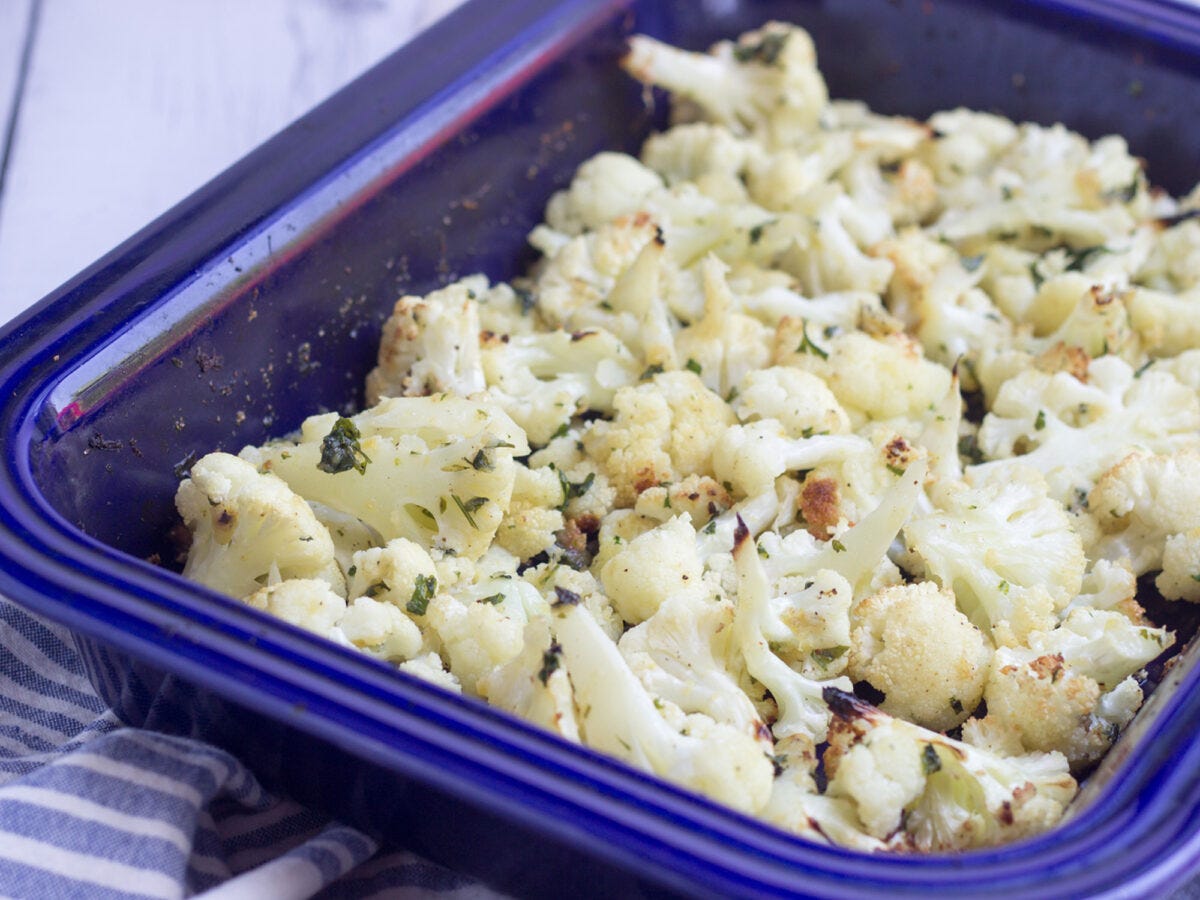
🥗 Cauliflower has gained popularity in recent years for its versatility—it can be rice, it can be pizza crust, it can even be mashed potatoes. Yes, you get the benefits of cauliflower no matter how you prepare it. But, I love this recipe for Garlic and Lemon Roasted Cauliflower because it celebrates cauliflower as itself, a tasty vegetable that makes the perfect side dish for just about any protein.
Add this recipe to your meal plan this week with Real Plans, the official Nutrivore meal planning app!
Nutrivore Mindset Corner
🧠Cauliflower is probably the most popular vegetable for healthifying foods, thanks to its relatively bland taste, low caloric density, and flexibility in the kitchen. You can buy cauliflower rice, cauliflower pizza crusts, and cauliflower dino nuggets. And, if you’re adventurous in the kitchen, you can make cauliflower gravy, cauliflower bread, and cauliflower chocolate cake. I think we can appreciate the added nutrient density of sneaking cauliflower into dishes, while rejecting the diet culture mentality that substitutes cauliflower for more carbohydrate-dense ingredients like rice, potatoes and flour to transform a “bad food” into a “good food.”
In personally love to blend cauliflower (and other veggies) with broth and adding it to soups to thicken them, and my favorite frozen pizza brand had a cauliflower crust. In my opinion, these are delicious ways to add in a few more veggies (and the valuable glucosinolates that cauliflower provides) that doesn’t take away from my enjoyment of the food I’m eating. But when it comes to rice, mashed potatoes, and chocolate cake, I opt for the real thing.
It can be a tricky mindset balance to choose some foods that are marketed using diet mentality while avoiding labeling these foods as “healthier” or “better” options. I remind myself that a healthy diet has room for all foods, and that it’s the relative proportions and variety of foods that I eat that determines whether my diet is overall one that supports my long-term health. And I remind myself that enjoying the foods I’m eating is a necessary precondition for sticking to my overall healthier eating patterns. Sometimes that means choosing the cauliflowery version of the food, and sometimes that means not, and both decisions are valid.
Learn everything you need to know about the Nutrivore philosophy in my book, Nutrivore: Eat Any Food, Get Every Nutrient, and Transform Your Health!
Helpful Tip of the Week
💡If you find cauliflower to be too bitter, perhaps even being able to taste it in hidden-veggie recipes like cauliflower pizza crust, you’re probably a bitter supertaster.
The glucosinolates in crucifers chemically resemble phenylthiocarbamide (PTC), an organic molecule with the very unusual property that it either tastes very bitter or is virtually tasteless depending on which variant of a taste receptor gene, called hTAS2R38, you have. On average, about 70% of us can detect a bitter taste in cruciferous vegetables, but those of us with two copies of the bitter sensitivity gene (called the PAV/PAV haplotype) are much more likely to hate them, eat fewer vegetables in general, and gravitate towards sweet treats!
But, never fear, because it is still possible to develop a liking for these bitter veggies!
If you genetically predisposed to disliking crucifers, try experimenting with different methods of cooking—for example, roasting as opposed to boiling may completely change the enjoyment you get from eating these veggies! Or you could try blanching before cooking to leach out some of the bitter compounds. To do this, bring water to a boil in a large pot. Add your veggies to the pot and cook for one to two minutes. Immediately transfer to ice water. It’s true that your choice of cooking method will have an impact on nutritional content and you may lose some of the nutrients but perhaps you may need to compromise on nutrients for taste. In the end, including this veggie in your diet in any form is a worthy addition—eating crucifers with less nutrients is better than not eating any at all! You might also find that balancing the bitterness with some astringency or acidity, such as tossing with lemon juice or a vinaigrette, may help too, or adding some sweetness like a little honey or maple syrup.
This Week’s Companion Downloads
📥For paid subscribers, your Companion Downloads this week are:
Top 10 Glucosinolates Foods Fridge List - This 1-pager PDF guide lists the top 10 common whole food sources of glucosinolates, how much glucosinolates you get per serving (and how much a serving is!), while highlighting a few other valuable nutrients each food provides.
Garlic and Lemon Roasted Cauliflower Recipe - A beautifully-designed PDF version of this week’s recipe that you can save or print out, to build your own personalized Nutrivore Cookbook week by week.
Check your inbox for the Companion Downloads arriving in a separate email (or if you use the Substack app, they’ll be in their own post). You can also find them in the archive here. Thank you so much for supporting my work and Nutrivore!
Sincerely,
Dr. Sarah Ballantyne, PhD
Founder of Nutrivore