
Don’t “glaze” over this folate-filled salmon recipe, especially if you have inflammation!
Vitamin B9 for inflammation, pomegranate molasses-glazed salmon, and why small steps are the best steps

👉This week, we’re talking about: how vitamin B9 lowers inflammatory markers, pomegranate as a good source of polyphenols and vitamin B9, two different ways to easily de-seed a pomegranate, why I prefer a step-by-step approach to health rather than the typical perfect-or-bust diet mentality, and I’m sharing my pomegranate molasses-glazed salmon recipe.
Key Takeaways
✅Vitamin B9 (aka folate) is one of those multi-tasking essential nutrients that lowers risk of more than a dozen health problems, including lowering inflammatory markers like C-reactive protein.
✅Pomegranates are famous for their polyphenols, but they’re also particularly valuable sources of fiber and vitamin B9, with a notable amount of potassium, too!
✅What matters is how you eat on average over years and decades, so instead of the on-again-off-again diet rollercoaster, I recommended embracing small steps and the best path towards lasting improvements in diet quality. (And I have structured resources to help you take those steps!)
✅For paid subscribers, your companion downloads this week are: Vitamin B9 (Folate) Fun Factsheet & Pomegranate Molasses-Glazed Salmon Recipe. Check your inbox; they’ll be arriving in a separate email (or if you use the Substack app, they’ll be in their own post).
Vitamin B9 (Folate) for Inflammation
🧬Vitamin B9 is also called folate, the generic term that refers to both naturally occurring dietary folates as well as a synthetic version called folic acid, which is used in fortified food and supplements. Like other B vitamins, folate is needed for producing healthy blood cells; it’s also required for healthy cell growth and function, and for making important genetic material like DNA. Folate also supports cardiovascular health, potentially protects against certain cancers, and reduces the risk of cognitive and neurological disorders later in life.
A number of studies have shown a beneficial effect of folate on inflammatory markers. A 2019 systematic review and meta-analysis of randomized controlled trials found that folic acid supplementation can significantly lower serum levels of C-reactive protein, which is produced by the liver in response to inflammation; this effect was particularly pronounced in women and in patients with type 2 diabetes. A 2021 systematic review and meta-analysis of randomized controlled trials echoed this finding, showing that compared to placebo, folic acid supplementation could improve inflammation by lowering serum concentrations of C-reactive protein.
Natural food sources of folate include liver and other organ meats, green leafy vegetables (like spinach and lettuce), asparagus, avocados, Brussels sprouts, legumes (including peas and lentils), eggs, beets, citrus fruits, orange juice, strawberries, pomegranates, broccoli, nuts, and seeds.
Want to know the top 25 best food sources of vitamin B9? Learn them here.
Get 17% DV Folate with Pomegranate
Pomegranate is famous for its cholesterol-lowering polyphenols (a 1-cup serving of pomegranate arils delivers a whopping 1241mg of polyphenols), but that’s not the only valuable nutrient you get from pomegranate!
A serving of pomegranate will also give you an impressive 7 grams of fiber, 31% DV copper, 24% DV vitamin K, 17% DV vitamin B9, 13% DV vitamin B5, and 10% DV vitamin B1. (You’ll also get 9% DV potassium, which is impressive considering an extra large banana only gives you 11% DV.) You get roughly 1.5 servings from one 4-inch-diameter pomegranate.
This week’s recipe features pomegranate molasses, made by simmering pomegranate juice down to a thick, sweet and tangy syrup, concentrating both the flavor and the nutrients!
Pomegranate is the 384th most nutrient-dense food! Learn the Top 500 Nutrivore Foods here.
Pomegranate Molasses-Glazed Salmon Recipe
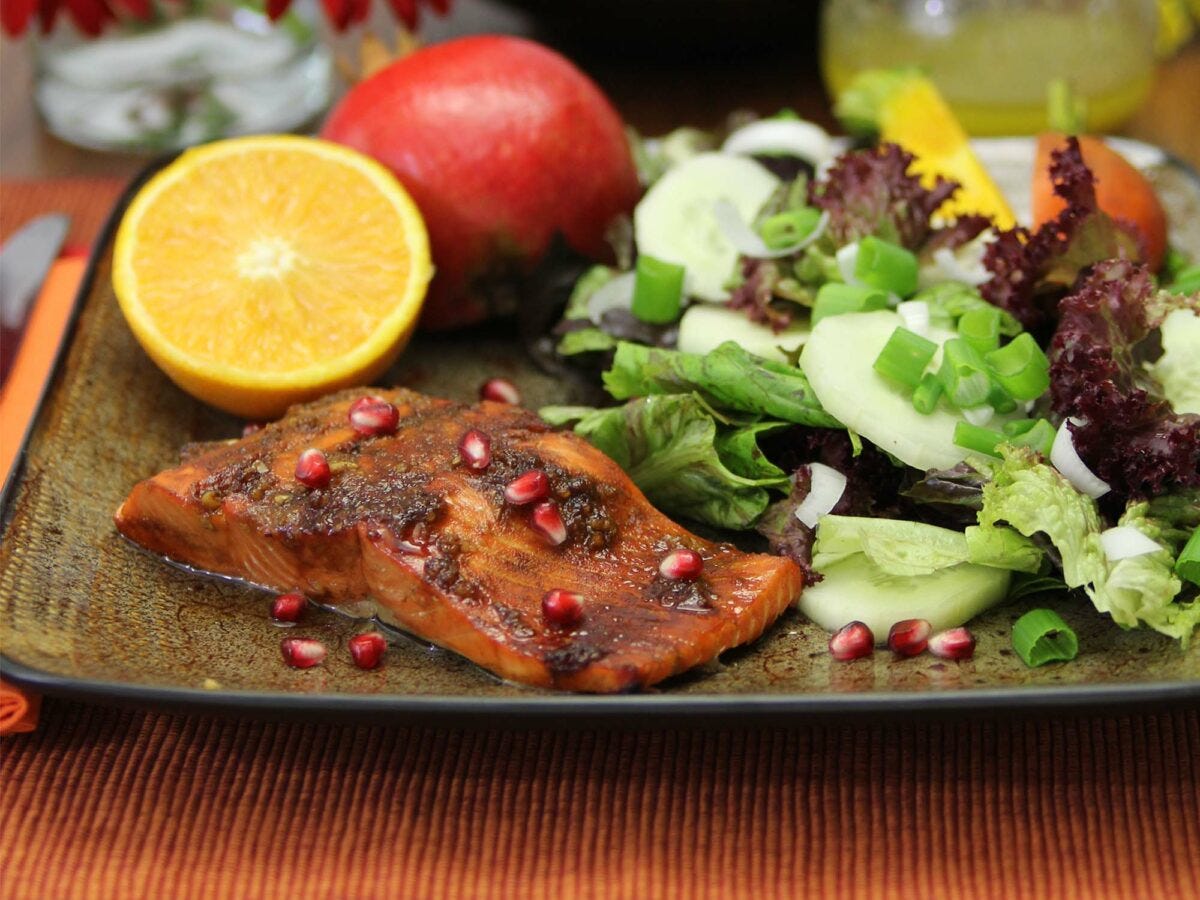
🥗 This recipe is truly packed with nutrients thanks to a swath of sneaky nutrilicious ingredients: the sweetening power and polyphenol-filled tang of pomegranate molasses, and the omega-3-packed nutrient bomb of salmon. Mix them all together and you get a bright, sweet, slightly spicy (thanks to the ginger), new favorite in your meal rotation! It’s like a honey garlic sauce, but amped up with a whopping Nutrivore Score of 595!
Add this recipe to your meal plan this week with Real Plans, the official Nutrivore meal planning app!
Nutrivore Mindset Corner
🧠Diet culture and all-or-nothing mentality go hand-in-hand, and the internet is packed with diet challenges that reinforce that perfect-or-bust message. So, it’s easy to believe that if you can’t overhaul your entire diet overnight, there’s no point in trying at all. Or, that if you indulge in a treat or eat something “off plan”, that that somehow wrecks all your progress. But it doesn’t matter how you eat today, or even all this week, what matters is how you eat on average over years and decades. And, the fact is that diet challenges rarely create lasting change. What does? Small steps! That means iterative diet improvements that don’t overwhelm but instead steadily build over time nutrient-dense health-promoting eating patterns that still make room for joy, step by step, so they healthy and balanced eating becomes a lifelong habit that actually sticks.
Small steps may not feel dramatic in the moment, but they compound, and each small step you take is worth feeling proud about. Adding a serving of vegetables to dinner, swapping a sugary snack for a piece of fruit, finding a new bean recipe that you love so it’s easy to eat regularly, or making a nutritious breakfast a daily ritual... these changes might seem insignificant on their own, but each of these small actions adds up to meaningful improvements in diet quality over weeks, months, and years. And that translates to better long-term health.
Sustainable habits are usually built gradually, through small adjustments that become easier and more automatic with practice. Progress doesn’t require perfection—it just requires consistency and the willingness to keep taking the next small step forward. And if you’re looking for a structure program to walk you through those steps, without going on a diet, that’s why I created the Nutrivore90 Online Course.
Instead of chasing quick fixes or rigid rules, Nutrivore90 is designed to help you build a more nutrient-dense way of eating, one manageable habit at a time. Over 90 days, you’ll focus on practical strategies that fit into real life, helping you create eating behaviors that support your health without restriction, guilt, or overwhelm. Because when small steps are repeated consistently, they become something much bigger: a sustainable foundation for lifelong health.
Helpful Tip of the Week
💡If the thought of de-seeding a pomegranate seems intimidating, here are a few suggestions to help you get out all that goodness! Before you start, remember pomegranates are messy and their ruby-red juice can stain!
One way to remove the seeds is simply to cut the pomegranate in half, scoring each half of the exterior rind four to six times with a sharp knife. Then, hold the pomegranate half seed-side down over a bowl, and smack the rind with a large wooden spoon ejecting the majority of the seeds. Only a few deeply embedded seeds will remain to remove from the pith (spongy white tissue).
Alternatively, you can cut the pomegranate in half, again scoring vertically into several segments and soak it in water for five to ten minutes. If you break the segments apart under water, the seeds will sink to the bottom of the bowl and the pulp will float to the top, making separation easy! Freezing the entire fruit may also makes it easier to separate.
To prepare pomegranate juice directly from the fruit, put the seeds in a blender and pulse to break up the seeds. Wait a few minutes, then pour through a strainer. Fresh pomegranate juice will last up to 5 days stored in the refrigerator but can also be frozen for up to a year.
This Week’s Companion Downloads
📥For paid subscribers, your Companion Downloads this week are:
Vitamin B9 Fun Factsheet - This 2-page PDF guide summarizes all the most important information about what vitamin B9 (folate) does, top food sources, and how much we need for each demographic group.This fun factsheet also explains the difference between natural folates and folic acid!
Pomegranate Molasses-Glazed Salmon Recipe - A beautifully-designed PDF version of this week’s recipe that you can save or print out, to build your own personalized Nutrivore Cookbook week by week.
Check your inbox for the Companion Downloads arriving in a separate email (or if you use the Substack app, they’ll be in their own post). You can also find them in the archive here. Thank you so much for supporting my work and Nutrivore!
Sincerely,
Dr. Sarah Ballantyne, PhD
Founder of Nutrivore