

👉This week, we’re talking about: fiber (but not fiber supplements) for Irritable Bowel Syndrome; what makes green beans so cool nutritionally; how to easily grow green beans at home; why green beans make it into my regular rotation even though they’re far from the most nutrient-dense vegetable; and I’m sharing my recipe for Simple Roasted Green Beans.
Key Takeaways
✅Fiber is arguably the most important nutrient for gut health, and low-fiber diets are believed to be the cause of Irritable Bowel Syndrome (IBS).
✅Green beans are a great source of fiber, vitamin K and vitamin C. Plus, they’re affordable and versatile. They also happen to be one of the easiest food crops to grow and are perfect for beginner gardeners and small spaces!
✅Choosing green beans instead of the “highest-scoring” vegetables is still a win because variety is part of what makes our overall diet nutrient-dense.
✅For paid subscribers, your companion downloads this week are: Nutrients for Gut Health and Simple Roasted Green Beans. Check your inbox; they’ll be arriving in a separate email (or if you use the Substack app, they’ll be in their own post).
Fiber for Irritable Bowel Syndrome
🧬Irritable bowel syndrome (IBS) is a diagnosis of exclusion, and refers to gastrointestinal symptoms—such as constipation, diarrhea, cramping, abdominal pain, bloating, and gas—without a clear cause such as IBD, celiac disease, diverticular disease or stomach ulcer. It’s estimated that 11% of people globally are affected by IBS. IBS is believed to be primarily caused by low dietary fiber causing an unhealthy gut microbiome.
Fiber is a type of complex carbohydrate that our body can't digest and instead is a food source for the beneficial bacteria and other microbes that inhabit our digestive tract. Fiber also regulates peristalsis of the intestines (the rhythmic motion of muscles around the intestines that pushes food through the digestive tract), stimulates the suppression of the hunger hormone ghrelin (so we feel more full), lowers cholesterol, and slows the absorption of simple sugars into the bloodstream to regulate blood sugar levels and avoid the excess production of insulin.
Fiber supplements have shown limited utility in IBS symptom management, likely because 1) fiber diversity is also extremely important, as very small differences in fiber structure can change which gut bacteria are supported; and 2) probiotics are additionally required to improve gut microbiome composition.
We get fiber diversity when our fiber comes from whole food sources. While pulse legumes and certain fruits and veggies stand out as being particularly fiber rich, all whole plant foods—whole grains, legumes, vegetables, fruits, nuts and seeds—contribute fiber to our diets.
Probiotics supplements containing Bacillus coagulans have the best track record for IBS, but Lactobacillus plantarum and Lactobacillus acidophilus have also been shown to be very beneficial. These strains are commonly found in many fermented foods—like yogurt, sauerkraut and kimchi—and probiotic-enriched foods.
Want to know the top 25 best food sources of fiber? Learn them here.
Get 2.7 g Fiber with Green Beans
🫛Green beans, also known as French beans, string beans, snap beans, wax beans, or Phaseolus vulgaris L. (for us science nerds) are odd-ball members of the legume (Fabaceae) family. Compared to most other legumes, green beans (and fresh peas) are harvested for their fresh pods, as opposed to dried seeds as in other legume varieties such as lentils or black beans. As such, their “seeds” are soft when raw, and due to their unripe or immature state, are lower in mineral binding phytates.
A serving of green beans is standardized to 1 cup, measured raw. When you cook them, they reduce in volume: 1 cup raw green beans is roughly equivalent to a little more than 3/4 cup boiled green beans. A serving of green beans delivers 2.7 grams of fiber (an impressive amount for a non-starchy veggie!), 36% DV vitamin K, 15% DV vitamin C, and 46 mg of antioxidant polyphenols. They have a Nutrivore Score of 605!
Green beans are the 215th most nutrient-dense food! Learn the Top 500 Nutrivore Foods here.
Simple Roasted Green Beans Recipe
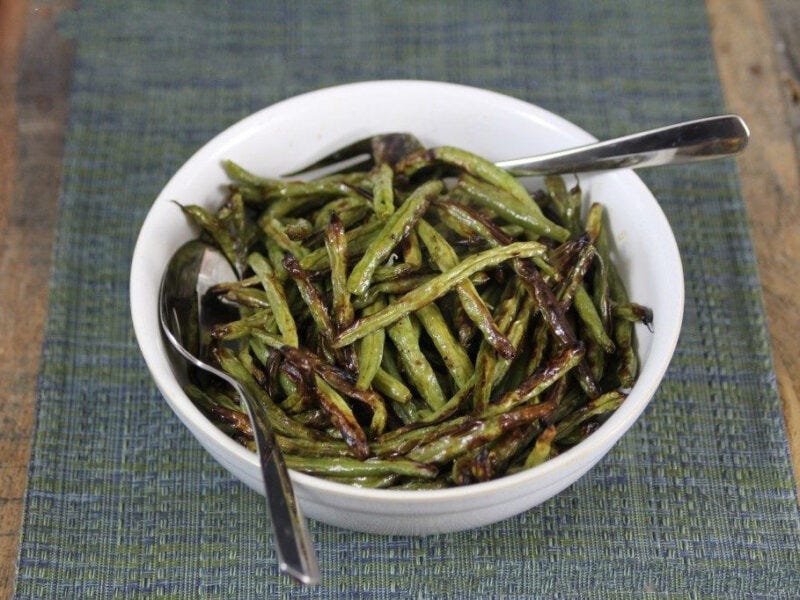
🥗 Fat, salt, green beans and heat—it’s a magical combination that creates Simple Roasted Green Beans. If you are looking for a simple side dish that can be thrown together quickly, this is it! You can scale this up or down very easily, and is delicious alongside any protein including steak, pork, fish or even chicken!
If you want to play with the seasoning, swap regular salt with truffle salt, garlic salt, or your favorite seasoning blend. It turns a simple vegetable into something amazing, and is packed with nutrients like fiber, vitamin K and and vitamin C.
Add this recipe to your meal plan this week with Real Plans, the official Nutrivore meal planning app!
Nutrivore Mindset Corner
🧠The Nutrivore Score is a measurement of nutrient density, scientifically defined as nutrients per calorie. It’s a simple number that can tell us the quality of the calories in a food. But, there are many important things that the Nutrivore Score can’t tell us. It doesn’t tell us what nutrients are in a food; it doesn’t tell us whether eating that food regularly improves health outcomes; and it doesn’t tell us whether the nutrients in that food fill nutritional gaps in our own diet or simply increase our intake of nutrients we were already getting enough of. So, the Nutrivore Score should never be the only metric we use for food choice.
Green beans are a great example. With their middle-of-the-road Nutrivore Score of 605, there are so many more nutrient-dense vegetables that we could choose. This makes it easy to get so wrapped in the gamification of meals, swapping out each component for a more nutrient-dense option, that we forget the value of dietary diversity, arguable the most important hallmark of a healthy diet. We also forget the value of affordability, convenience, and flavor! I enjoy green beans. They’re versatile enough to add to just about any dish, and I find it easy to eat a huge pile of them, which helps me reach my daily vegetable serving goals. Plus they’re so abundant in my garden right now that I’m freezing them for winter just so that I don’t have to eat them every day. Could I choose something more nutrient dense? Sure. But at the risk of sounding like a broken record: let’s not let perfection be the enemy of the good.
And remember, that every vegetable family offers its own special collection of phytonutrients and fiber types, so there’s actually more health benefit from mixing it up than there is from always going for the most nutrient dense. So, if green beans are the vegetable you like, have access to, and can afford, that’s awesome!
Learn everything you need to know about the Nutrivore philosophy in my book, Nutrivore: Eat Any Food, Get Every Nutrient, and Transform Your Health!
Helpful Tip of the Week
💡Green beans are one of the easiest plants to grow! They grow best from seed and don’t like being transplanted, which means you don’t need to worry about up-potting seedlings! They grow best in warm weather (it’s not too late to plant them in most zones right now, and they produce very quickly), in full-sun, and in well-drained soil. They don’t need fertilizer and are a nitrogen-fixing plant, so they can actually improve growing conditions for neighboring plants. They don’t need pruning, pole varieties will climb up a trellis, fence or even strings all by themselves (no training required), the blooms are pretty, and they’ll keep producing until the first frost.
Bush beans don’t need a trellis and can grow in very limited space. I like to plant them around the edges of my vegetable garden, and in any small empty spaces, to make the best use of every square inch of soil. You can also grow them in pots! I prefer to plant purple and yellow varieties, since they’re easier to see for harvesting than green varieties. And if you have a small trellis, try a long-bean variety (like yard-long beans, snake beans, or asparagus beans) for the most food per garden space.
This Week’s Companion Downloads
📥For paid subscribers, your Companion Downloads this week are:
Nutrients for Gut Health - This 1-pager PDF guide lists all the nutrients that reduce risk of diseases of the gastrointestinal system along with top food sources, to give you a quick-reference for foods to add if gut health is a concern for you.
Simple Roasted Green Beans Recipe - A beautifully-designed PDF version of this week’s recipe that you can save or print out, to build your own personalized Nutrivore Cookbook week by week.
Check your inbox for the Companion Downloads arriving in a separate email (or if you use the Substack app, they’ll be in their own post). You can also find them in the archive here. Thank you so much for supporting my work and Nutrivore!
Sincerely,
Dr. Sarah Ballantyne, PhD
Founder of Nutrivore