

👉This week, we’re talking about: how getting enough vitamin B6 can lower frequency and severity of migraine headaches; poultry as a reliable source of vitamin B6; how to calculate your daily protein; why restrictive diets doom us to failure; and my Barbecue Chicken Thighs with Arugula Pesto recipe.1
Key Takeaways
✅Getting enough vitamin B6 (especially in conjunction with other B-vitamins) reduces frequency and severity of migraine headaches.
✅Dark meat chicken is similarly nutritious as light meat chicken, while being harder to overcook and typically much more affordable.
✅The most important step for calculating your daily protein is Step 3, where we check to make sure that we’re not aiming for too much.
✅For paid subscribers, your downloads this week are: Vitamin B6 2-page Fun Factsheet and Barbecue Chicken Thighs with Arugula Pesto
Vitamin B6 for Migraine Headaches
🧬A whopping 14% of people get migraines, and 1 in 22 people endure a headache more than half of the days each month. One of the nutrients that could make a big difference is vitamin B6.
A 2024 analysis showed that low dietary vitamin B6 (especially in conjunction with low dietary vitamin B9) was strongly associated with increased risk for migraine headaches—eating a diet that supplied at least 50% more than the daily value of vitamin B6 on a daily basis lowered the odds of getting a migraine.
A 2015 double-blind randomized controlled clinical trial showed that a high-dose vitamin B6 supplement for 12 weeks reduced migraine severity and duration in patients who suffer recurrent migraine headaches with aura. A 2022 double-blind randomized controlled clinical trial compared high-dose vitamin B6 supplementation to vitamin B1, vitamin B9, vitamin B12, and a B-complex supplement that contained all four for episodic migraines. The strongest benefit to the Migraine Disability Assessment Questionnaire which assesses migraine-related disability was seen for vitamin B6, lowering migraine headache frequency and severity (note that all of the B-vitamins analyzed in this study were beneficial).
And finally, a 2020 systematic review found that vitamin B6, alone or in combination with other B vitamins (especially vitamin B9 and vitamin B12), was effective for helping prevent migraines with aura in adults.
Want to know the top 25 best food sources of vitamin B6? Learn them here.
Get 19% DV Vitamin B6 with Dark Meat Chicken
🍗All poultry is a reliable source of vitamin B6, including chicken, turkey, goose, duck, quail, light meat, dark meat, and giblets. For example, dark meat chicken has 19% DV per 3.5-ounce serving (measured raw, that’s about 3 ounces once cooked). While white meat seems to get all the love (especially as a weight loss diet-friendly protein), dark meat is similarly nutrient-dense with its Nutrivore Score of 281 (only 8% lower than white meat chicken), and is a particularly valuable source of protein, taurine, coQ10, vitamins B2, B3, B5, B6, B7 and B12, selenium and zinc.
Dark meat chicken has the added bonus of not drying out as easily when overcooked, and generally being more affordable!
Dark meat chicken is the 365th most nutrient-dense food! Learn the Top 500 Nutrivore Foods here.
Barbecue Chicken Thighs with Arugula Pesto
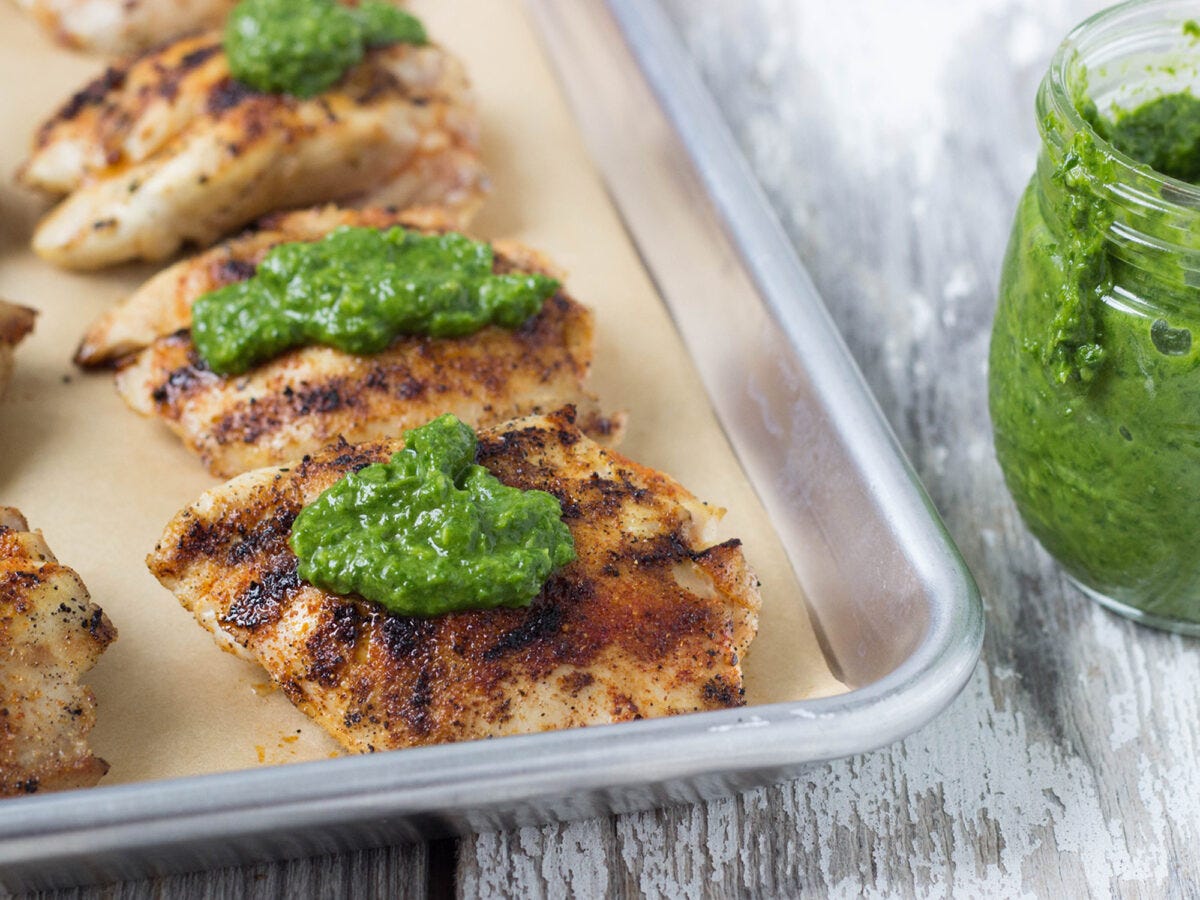
🥗 Few recipes have been as consistent a part of my rotation for as many years as this barbecue chicken. In fact, I regularly make quadruple batches of the spice rub from this recipe to have on hand as an all-purpose seasoning or just to use the next time I barbecue chicken thighs to make it even more convenient.
Add this recipe to your meal plan this week with Real Plans, the official Nutrivore meal planning app!
Nutrivore Mindset Corner
🧠Let’s talk about restrictive diets—because odds are, if you’ve ever tried to improve your eating, you’ve been told to start by cutting things out. But here’s the truth: restriction doesn’t work long-term. Diets that rely on willpower to avoid ‘bad’ foods tend to backfire. Studies show they lead to food obsession, binge eating, disordered eating patterns, weight cycling, and a damaged relationship with food.
In a 2105 study, participants were asked to rate on a scale from “not at all true for me” to “very true for me” eleven questions such as “I view my attempts to diet as either successes or failures” and “I think of food as either good or bad”. One to four points were assigned for each answer, altogether giving the study participants a score on the Dichotomous Thinking in Eating Disorders Scale. For every point higher on the scale (specifically, the Eating Subscale), participants had a whopping 142% higher chance of regaining lost weight instead of maintaining lost weight. Furthermore, this study showed that higher dichotomous thinking, higher food restraint, and dieting all went hand in hand, and were each predictive of weight regain.
Food prohibition tends to cause fixation and can trigger disinhibition. Disinhibition refers to when, after giving into that one thing that was against your rules, that piece of cake or that day of being a couch potato, your health behaviors unravel, driving more and more unhealthy choices. Basically, disinhibition is the technical term for falling off the proverbial wagon.
In a 2007 study, kids were given a bowl of yellow and red M&Ms and told they could eat as many as they wanted. In the first phase, one group of kids had no restrictions whereas the other was told they weren’t allowed to eat the red ones; and in the second phase, both groups of kids were told they could eat as many M&Ms as they wanted of either color. The kids who were at first prohibited from eating red M&Ms, had an increased desire for them; when the kids were finally allowed to eat whatever M&Ms they wanted in the second phase, they ate a higher proportion of red ones compared to the kids who didn’t have any restrictions. Perhaps not surprisingly, the kids who had food restrictions at home ate the most M&Ms (and total calories) in the study, regardless of which group they were in.
This effect isn’t limited to children. When we label a food as “bad” and tell ourselves we’re not allowed to eat it, the net result is that we become fixated on that food. When we eventually succumb to our craving, our eating behaviors unravel, and the diet yo-yo begins its upwards momentum. This can also set the stage for disordered eating patterns.
Restriction turns eating into a moral issue. It disconnects you from your hunger and fullness cues and sets you up to feel like you’re either succeeding or failing at every meal.
Let’s flip that script. Instead of controlling food, we focus on adding in nutrient-dense foods to support your health and we build consistency of healthier eating patterns by intentionally making room for joy and treats, too. This shift—from restriction to nourishment and permission—is the key to sustainable change.
Learn everything you need to know about the Nutrivore philosophy in my book, Nutrivore: Eat Any Food, Get Every Nutrient, and Transform Your Health!
Helpful Tip of the Week
💡Let’s talk protein, and how to figure out how much to aim for. While the RDA is set at 0.8 grams of protein per kilogram bodyweight, remember that RDAs are based on avoiding deficiency, not necessarily on what’s best for our overall health. A number of scientific studies show that the optimal dietary protein range for most people is 1.2 to 1.8 grams of protein per kilogram of bodyweight, with higher intakes (up to 2.4 g/kg) appropriate for athletes or people in a calorie deficit.
Here’s how to calculate your range:
Step 1: Convert your weight to kilograms.
If you know your weight in kilograms, awesome!
If you know your weight in pounds, divide that number by 2.2 to get your weight in kilograms.
Example: 150 pounds ÷ 2.2 = 68 kg
Step 2: Multiply your weight in kilograms by your protein target range.
Multiply your weight in kilograms by both the lower end and upper end of the optimal protein range to get your target number of grams per day.
Example: For a 68-kilogram person:
Lower end: 68 kg × 1.2 g = 82 grams protein/day
Upper end: 68 kg × 1.8 g = 122 grams protein/day
Step 3: Make sure you’re within the AMDR for protein.
Protein should make up no more than 35% of your total calories (otherwise, it increases your risk of cardiovascular disease). Since each gram of protein provides 4 calories, you can do a quick check:
Multiply your daily calorie target by 0.35
Divide that number by 4 to get your upper limit in grams
Example: For a 2,000-calorie diet:
2,000 × 0.35 = 700 calories from protein
700 ÷ 4 = 175 grams protein/day maximum
Make sure this number is higher than the upper end calculated in Step 2. If it’s not, this number is your new upper end protein target.
Example: 122 grams is less than 175 grams, so we’re good!
This check ensures your protein intake stays within a healthy range and leaves room for other essential nutrients.
Step 4: Break your protein target into meals
To make it easier to meet your daily protein goal, divide your range by 3 to estimate how much protein to include at each meal:
Lower end example: 82 grams ÷ 3 meals = ~27 grams per meal
Upper end example: 122 grams ÷ 3 meals = ~41 grams per meal
This gives you a ballpark to aim for without needing to track every bite. You can also spread protein across 3 meals and 1–2 snacks (for example: 25g at breakfast, lunch, and dinner, plus a 10–20g protein snack). Eating protein consistently throughout the day—rather than loading it all into one meal—supports better digestion, energy, satiety, and muscle retention.
And remember that all dietary protein counts here, not just your “protein foods”, so count the protein in meat, seafood, eggs, dairy products, vegetables, grains, legumes, fruit, and nuts, too.
Watch & Learn
🎥Check out my YouTube videos on tips to get enough protein and more details on calculating your protein requirements! And don’t forget to subscribe and hit bell notifications, so you never miss a new video!
This Week’s Downloads
📥For paid subscribers, your downloads this week are:
Vitamin B6 Fun Factsheet - This 2-page PDF guide summarizes all the most important information about what vitamin B6 does, top food sources, and how much we need for each demographic group.
Barbecue Chicken Thighs with Arugula Pesto - A beautifully-designed PDF version of this week’s recipe that you can save or print out, to build your own personalized Nutrivore Cookbook week by week.
You can find buttons to download at the bottom of this Substack. Thank you so much for supporting my work and Nutrivore!
Sincerely,
Dr. Sarah Ballantyne, PhD
Founder of Nutrivore
Medical Disclaimer: The information provided in this Substack is for educational purposes only and is not intended as a substitute for professional medical advice, diagnosis, or treatment. Always seek the advice of your physician or another qualified healthcare provider with any questions you may have regarding a medical condition or dietary changes.
FTC Disclosure: Some links in this Substack may be affiliate links, meaning I may earn a small commission if you purchase through them at no additional cost to you. I only recommend products I genuinely believe in. Thank you for supporting my work!
