
How does steak fit into a healthy diet?
CLA for rheumatoid arthritis, where the science is at on red meat,

👉This week, we’re talking about: Conjugated Linoleic Acid (CLA) for rheumatoid arthritis, how much red meat can fit into a healthy diet, tips for moderating red meat consumption and building a pattern of healthy eating that can include red meat, why it’s important not to swing the food label pendulum from “terrible” to “amazing”, and I’m sharing one of my summertime favorite recipes: Grilled Peach and Steak Salad.
Key Takeaways
✅Conjugated Linoleic Acid (CLA) is a very special naturally-occurring trans fat with several exciting health benefits, including lowering inflammation in rheumatoid arthritis!
✅Red meat has some valuable nutrition, so it’s good news that the science currently shows neutral to slightly beneficial effects of eating it in moderation.
✅Just because red meat isn’t bad, that doesn’t mean eat as much of it as we want. Below, I discuss the pendulum swing of food labels and how to moderate red meat consumption.
✅For paid subscribers, your companion downloads this week are: Nutrients for Autoimmune Disease and Grilled Peach and Steak Salad. Check your inbox; they’ll be arriving in a separate email (or if you use the Substack app, they’ll be in their own post).
Conjugated Linoleic Acid for Rheumatoid Arthritis
🧬Conjugated linoleic acid, or CLA, is a type of omega-6 polyunsaturated fat that’s technically a trans fat (due to the presence of a double bond in the trans configuration). But contrary to what we might expect, it’s widely known as being health-promoting! CLA exhibits a range of anti-cancer, anti-heart disease, anti-obesity, and anti-diabetes activities, while also serving a beneficial role in immunity and gut health.
Some evidence suggests CLA could benefit rheumatoid arthritis. A 2014 double-blind controlled trial found that CLA, especially when combined with vitamin E, was able to lower markers of inflammation in rheumatoid arthritis patients. And, a small 2016 randomized controlled trial showed that among patients with active rheumatoid arthritis, supplementation with 2 g of CLA daily (in addition to standard treatment) had a positive effect on bone markers, compared to standard treatment alone. Specifically, the CLA led to improved activity of telopeptides C, osteocalcin, and IGF-1! Rodent models of rheumatoid arthritis have also shown a powerful effect of CLA on disease symptoms, including significantly reducing arthritic scores, delaying the onset of arthritis, and reducing markers of inflammation.
The best sources of CLA are meat and dairy products from grass-fed animals—particularly grass-fed beef, grass-fed lamb, butter and cheese from grass-fed dairy, and other full-fat dairy products. Importantly the CLA content of meat and dairy is up to 500% greater when the animals graze on pasture versus eat grain, so while some CLA also exists in grain-fed meat and dairy products, the amount is significantly lower.
Want to know the top 25 best food sources of CLA? Learn them here.
Get up to 225 mg CLA with Steak
🥩Steak can definitely fit into a healthy diet! Red meat gets a bad rap, but studies typically quote to demonize red meat often put processed meats and red meat in the same food category. When red meat and processed meats are instead analyzed separately, the stronger association with negative health outcomes is with processed meats, not red meat. For example, a huge 2017 meta-analysis that incorporated data from 123 studies showed that red meat actually slightly decreases risk of coronary heart disease up to intakes of about 65 grams per day (the equivalent of eating four 3.5-ounce (100-gram) servings per week), whereas the risk was higher with any intake of processed meats (and higher for greater intakes of red meat, especially above 1 serving per day). And a 2010 meta-analysis criticized the World Cancer Research Fund for lowering its recommended limit of red meat consumption to 71 grams (2.5 ounces) per day for exactly this reason, the fact that many studies pool red meat and processed meat together, meaning there isn’t a strong scientific underpinning for this recommendation.
Interventional studies, where study participants substitute red meat for something else in their diet and then health outcomes are measured, show that it might not matter how much red meat you consume as long as the rest of your diet is diverse, nutrient-dense, and abundant in vegetables. In fact, a 2019 review of interventional studies concluded that the evidence is not strong enough to recommend reducing red meat consumption at all.
That being said, there’s enough conflicting data on this topic that it is still prudent to moderate red meat consumption (say, sticking with 3 or 4 small servings per week), while making sure we’re eating plenty of vegetables, fruit, legumes, nuts, and seafood.
A 3.5-ounce serving of beef round, tip center steak provides a whopping 187% the daily value of vitamin B12, plus 55% DV selenium, 48% DV zinc, 31% DV vitamin B6, 31% DV vitamin B3, 15% DV choline, 15% DV vitamin B5, 14% DV vitamin B2, 13% DV biotin, 11% DV iron, 3.0 mg of coQ10 and 45 mg of CLA when conventionally-raised (and about 5 times more CLA when grass-fed). In fact, this cut of steak has a Nutrivore Score of 403!
Two different steak cuts are the 254th and 292nd most nutrient-dense food! Learn the Top 500 Nutrivore Foods here.
Grilled Peach and Steak Salad Recipe
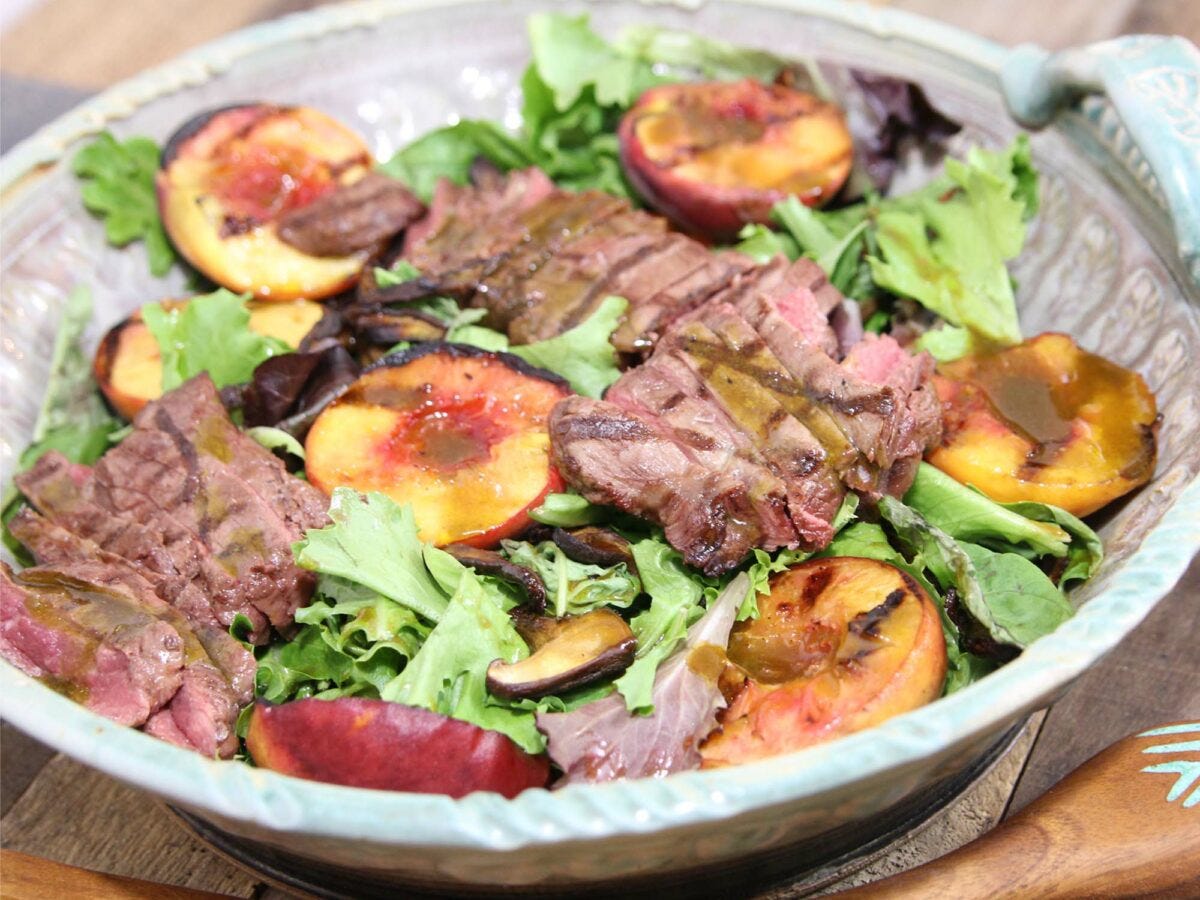
🥗 The combination of basil and peaches with the hearty beef is the perfect blend of earthy, aromatic, and sweet all in one delicious and filling meal!
Make a double batch of this salad, as I promise you will be wanting leftovers for your lunch all week (add the dressing right before you serve). Also the delicious balsamic vinaigrette is one of my favorites and can be used for just about any salad, as its tangy kick goes well with any kind of salad ingredient: bitter green, sweet fruit, crunchy nut, or garden-fresh vegetable!
Add this recipe to your meal plan this week with Real Plans, the official Nutrivore meal planning app!
Nutrivore Mindset Corner
🧠Whenever I say “red meat is not bad”, someone hears “all I should eat is red meat.” So let’s talk about the pendulum swing of labeling foods as “good” or “bad.”
Red meat was villainized for decades as the cause of heard disease and color cancer, but more recent science points to processed meat as a more likely culprit, along with what often goes along with high-red-meat diets (i.e., low intake of vegetables, inadequate fiber, sedentary lifestyle, and smoking. But just because we want to stop labeling red meat as “terrible”, that doesn’t mean we want the pendulum to swing all the way to “amazing.” Yet, that’s what is happening with certain fad diets right now, which have elevated red meat to near-mythical status, even claiming it can meet all of our nutritional needs on its own (it can’t).
The reality is that red meat is a nutrient-dense food that provides high-quality protein, iron, zinc, and several B vitamins. At the same time, it’s not a complete food—it lacks key nutrients like vitamin C, fiber, and a wide array of phytonutrients that we only get from plant foods. Science shows us that red meat in moderation is neutral or beneficial to our health, and that high intake may increase risk of some health problems. That means red meat can absolutely have a place in a healthy diet, in moderation and as part of a pattern of eating that embraces dietary diversity and includes plenty of fruits, vegetables, legumes, seafood, nuts and seeds.
When we move away from labeling foods as inherently “good” or “bad,” we create space for a more practical and sustainable approach: moderation and context. Instead of asking whether steak is healthy or unhealthy, we can ask how it fits into the overall pattern of what we’re eating. Are we pairing it with a variety of colorful plants? Are we balancing it with other protein sources throughout the week? These questions are far more useful—and far more aligned with long-term health—than trying to categorize a single food as universally beneficial or harmful.
This is the heart of the Nutrivore mindset: nourishment, not judgment. Foods like red meat don’t need to be feared or idolized—they just need to be understood. By stepping off the pendulum and focusing on balance, variety, and nutrient density, we can build a way of eating that supports health without sacrificing flexibility, enjoyment, or common sense.
Learn everything you need to know about the Nutrivore philosophy in my book, Nutrivore: Eat Any Food, Get Every Nutrient, and Transform Your Health!
Helpful Tip of the Week
💡If you’re looking to moderate red meat while still enjoying satisfying, nutrient-dense meals, a simple strategy is to make targeted swaps in familiar recipes. For example, you can swap ground beef for ground chicken or turkey in tacos, chili, or pasta sauces, or use textured vegetable protein (TVP), tempeh, or plant-based ground meats as alternatives. Another easy option is a half-and-half approach—replace half the ground beef with lentils in dishes like Bolognese or sloppy joes to boost fiber and nutrient diversity without sacrificing texture or flavor. For whole cuts, try rotating in chicken thighs, pork, or seafood like salmon or shrimp, depending on the dish. And for sandwiches or quick lunches, consider swapping deli meats for options like leftover roasted chicken, tuna salad, egg salad, hummus, or bean-based spreads to reduce reliance on processed meats while still keeping things convenient. And of course, opting for vegetarian recipes for some of your meals, like enjoying Meatless Mondays, can be a great way to both up your intake of health-promoting plant proteins while moderating red meat.
Another helpful approach is to think in terms of meal building rather than ingredient elimination. If you’re having steak, consider making it one component of a more balanced plate, so you can opt for a smaller serving while pairing it with roasted vegetables, a hearty salad, and/or a legume-based side dish. (My recipe for Grilled Peach and Steak Salad above is a great example!) This keeps red meat in your diet while naturally increasing the variety of nutrients you’re getting from other foods.
This is also exactly what we practice in Nutrivore90. The goal isn’t to cut out foods like red meat, but to build eating patterns where they fit into a broader, nutrient-dense framework. By focusing on balance, variety, and adding in foundational foods, Nutrivore90 helps you move away from all-or-nothing thinking and toward a way of eating that supports health, flexibility, and long-term sustainability.
This Week’s Companion Downloads
📥For paid subscribers, your Companion Downloads this week are:
Nutrients for Autoimmune Disease - This 1-pager PDF guide lists all the nutrients that reduce risk of autoimmune diseases along with top food sources, to give you a quick-reference for foods to add if autoimmune disease is a concern for you.
Grilled Peach and Steak Salad Recipe - A beautifully-designed PDF version of this week’s recipe that you can save or print out, to build your own personalized Nutrivore Cookbook week by week.
Check your inbox for the Companion Downloads arriving in a separate email (or if you use the Substack app, they’ll be in their own post). You can also find them in the archive here. Thank you so much for supporting my work and Nutrivore!
Sincerely,
Dr. Sarah Ballantyne, PhD
Founder of Nutrivore