

👉This week, we’re talking about: the potential for vitamin B5 to improve morning stiffness and pain in people with rheumatoid arthritis; blue cheese as a good source of vitamin B5; foods (like cheese) that aren’t nutrient dense but that still fill important nutritional niches and support long-term health; when to throw out moldy cheese; and I’m sharing my recipe for Blue Cheese Vinaigrette!
Key Takeaways
✅Rheumatoid arthritis studies have shown that vitamin B5 can improve symptoms, especially morning stiffness and pain.
✅Cheese is my go-to example of a low nutrient density food that still fills an important nutritional niche and contributes to good health.
✅Not sure if you need to throw out that moldy cheese? Explanations are below!
✅For paid subscribers, your companion downloads this week are: Top 10 Vitamin B5 Foods Fridge List and Blue Cheese Vinaigrette. Check your inbox; they’ll be arriving in a separate email (or if you use the Substack app, they’ll be in their own post).
Vitamin B5 and Rheumatoid Arthritis
🧬Pantothenic acid, also called vitamin B5, is a water-soluble B vitamin that, like other B vitamins, plays an important role in energy metabolism—breaking down the carbohydrates, fat, and protein we eat for use as fuel. B vitamins are also imperative for neurotransmitter production, cellular function, and a wide variety of organ functions.
Preliminary research suggests that pantothenic acid could improve symptoms of rheumatoid arthritis. People with this condition generally have lower blood levels of pantothenic acid compared to healthy individuals, with the lowest levels correlating with the most severe symptoms. Other studies have shown that supplementing with the calcium pantothenate can improve rheumatoid arthritis symptoms, particularly morning stiffness and pain, however, the mechanisms behind these improvements aren’t clear, and more research on this topic is needed!
The richest sources of pantothenic acid include organ meats (especially liver and kidneys), red meat, shellfish, oily fish, dairy products, eggs, lentils and other legumes, mushrooms, avocados, seeds (especially sunflower seeds and flaxseeds), whole grains, and sweet potatoes.
Want to know the top 25 best food sources of this nutrient? Learn them here.
Get 15% DV Vitamin B5 with Blue Cheese
🧀Blue cheese is a generic term referring to several varieties of cheese characterized by blue, black, green, or grey veins or spots of mold. It can be prepared from pasteurized cow’s, goat’s, or sheep’s milk, and is ripened with cultures of penicillium mold. During production, an inoculum of Penicillium roqueforti is introduced into the cheese, and then it is left to age in a temperature-controlled environment for 2 to 3 months.
While not very nutrient dense with its Nutrivore Score of 130, blue cheese still has lots of valuable nutrition to offer us! A serving (1.5 ounces or about 1/3 cup crumbled) delivers 9 grams of protein, 21% DV vitamin B12, 17% DV calcium, 15% DV vitamin B5, 12% DV vitamin B2, 11% DV selenium, and 10% DV zinc.
Blue cheese is the 483rd most nutrient-dense food! Learn the Top 500 Nutrivore Foods here.
Blue Cheese Vinaigrette Recipe
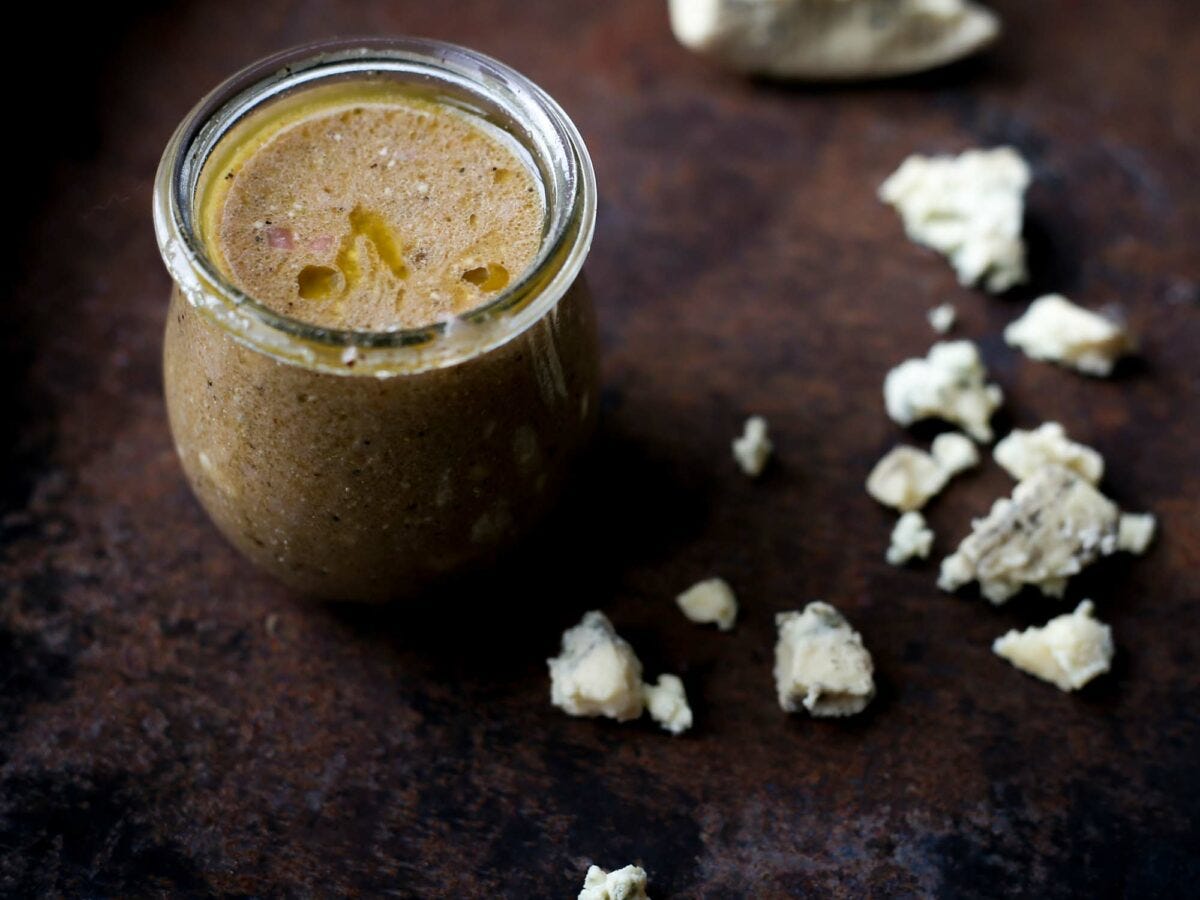
🥗 This rich vinaigrette is a delicious addition to your favorite salad. The layers of flavor from the aromatic shallots, blue cheese, and Dijon combined with the sweet honey and silky fattiness of olive oil give this salad dressing not only a flavor boost, but a nutrition boost to boot!
This recipe has a higher Nutrivore Score than a simple balsamic vinaigrette, even with the addition of blue cheese. That gives you an idea of the hidden nutrients in this flavor-bomb ingredient.
Add this recipe to your meal plan this week with Real Plans, the official Nutrivore meal planning app!
Nutrivore Mindset Corner
🧠Low nutrient density foods can still fill important nutritional niches and contribute to good health, and cheese is my go-to example.
One of the most important insights from the Nutrivore Score calculation is that the math makes it clear that all foods lie on a spectrum of nutrient density. There is no cusp above which a food is “good” and below which a food is “bad”. While any food with a Nutrivore Score over 150 contributes more nutrients than calories to the diet, there are plenty of examples of foods with lower scores that are still incredibly valuable sources of nutrients. Cheese has an average Nutrivore Score of 140 but is also the most concentrated food source of calcium, which an estimated 55% of Americans routinely fall short of the Estimated Average Requirement.
And cheese, in moderation, is good for us! A 2021 meta-analysis of 55 prospective cohort studies found that dairy consumption in general was associated with a 10% lower risk of stroke, a 4% lower risk of coronary heart disease, and a 9% reduced risk of hypertension (high blood pressure). A 2016 meta-analysis of 29 cohort studies showed that cheese reduced cardiovascular disease risk, and fermented dairy reduced total mortality risk, albeit by a modest amount (2% per 20 gram serving of fermented dairy or 10 gram serving of cheese).
Another great example is white rice, which is totally underwhelming from a nutrient density perspective, yet research has shown that white rice can indeed contribute to good health. This is thanks to its resistant starch content, which has significant prebiotic activity, meaning it feeds probiotic bacteria in our guts, greatly benefiting gut and, by extension, overall health. In a 2011 study of over 83,000 Japanese adults, steamed rice consumption was associated with reduced risk of cardiovascular disease in men, even after adjusting for other diet and lifestyle factors. The men who ate the most rice had a 30% reduced risk of coronary heart disease and heart failure, and an 18% reduced risk of cardiovascular disease, compared to the men who ate the least amount of rice.
All this to say that it’s important to understand what balanced, overall healthy eating patterns look like, rather that judge the worthiness of each food by its numbers, even a number as insightful as the Nutrivore Score.
Learn everything you need to know about the Nutrivore philosophy in my book, Nutrivore: Eat Any Food, Get Every Nutrient, and Transform Your Health!
Helpful Tip of the Week
💡If mold is used in the cheese-making process, why is it a problem when mold grows on my cheese at home?
The types of molds that give blue cheese, Roquefort, gorgonzola, camembert, brie, etc. their delicious and distinctive flavors and textures are carefully selected food-safe strains that are grown under tightly controlled conditions. That fuzzy blue corner on your cheddar, however, is a wild mold from the environment. It might be harmless, and it also might cause food-borne illness, not just due to mycotoxins but also to the possibility of pathogenic bacterial like salmonella and E. coli growing with the mold. And, there’s no way to tell just by looking at it or by its smell; so if you find mold on your cheese at home, here’s what to do…
For blocks of hard cheeses like cheddar, Parmesan, Swiss, or Gouda, you can generally cut away the moldy parts and the remaining cheese will be safe to eat. This is because mold usually can’t spread very far through the dense texture of hard cheeses. If you see mold, cut away at least 1 inch (2.5 cm) in every direction around the moldy area and discard that chunk. Be careful not to let your knife touch the mold as your cutting, which could spread mold spores into the as-yet-unaffected cheese.
For grated cheese, pre-sliced cheese, crumbled cheese and soft cheese like goat cheese, brie and cottage cheese, if you find mold, just throw the whole thing out. For cheeses made with molds like blue cheese, throw them out if they develop mold that looks different from normal.
This Week’s Companion Downloads
📥For paid subscribers, your Companion Downloads this week are:
Top 10 Vitamin B5 Foods Fridge List - This 1-pager PDF guide lists the top 10 common whole food sources of vitamin B5, how much vitamin B5 you get per serving (and how much a serving is!), while highlighting a few other valuable nutrients each food provides.
Blue Cheese Vinaigrette Recipe - A beautifully-designed PDF version of this week’s recipe that you can save or print out, to build your own personalized Nutrivore Cookbook week by week.
Check your inbox for the Companion Downloads arriving in a separate email (or if you use the Substack app, they’ll be in their own post). You can also find them in the archive here. Thank you so much for supporting my work and Nutrivore!
Sincerely,
Dr. Sarah Ballantyne, PhD
Founder of Nutrivore