

👉This week, we’re talking about: the benefits of beta-glucan fiber; how overnight oats and muesli have even more beta-glucan than cooked oats; tips for increasing fiber intake; why I built Nutrivore as a permissive approach to healthy eating; fruits and vegetables are both fiber foods and carbohydrate foods; and I’m sharing my Double Berry Swiss Oatmeal recipe.1
Key Takeaways
✅Beta-glucan is a fiber type that is particularly good at lowering cholesterol and improving blood sugar regulation.
✅Raw preparations of oats like overnight oats and muesli can have up to triple the beta-glucan content of cooked oats.
✅If you’re looking to up your fiber intake, I share specific recommendations from the scientific literature on how much to add per week.
✅For paid subscribers, your downloads this week are: Top 10 Fiber Foods Fridge List and Double Berry Swiss Oatmeal
Beta-Glucans for Metabolic Health
🧬Beta-glucan fiber is particularly beneficial. It increases the viscosity of the chyme in the upper GI tract, leading to increased binding and secretion of bile acids; in turn, plasma cholesterol becomes a substrate for newly formed bile, causing blood levels to decrease. The gel formed by beta-glucans in the intestine likewise forms a barrier that slows down the absorption of glucose. And another mechanism of action is the short-chain fatty acids produced when beta-glucan is fermented by gut bacteria; these short-chain fatty acids then inhibit cholesterol biosynthesis and affect carbohydrate metabolism.
In over a dozen studies, oat consumption has been shown to improve levels of both fasting and post-meal blood sugar and insulin. In fact, meals containing between 6 and 8.4 grams of fiber from oats can reduce the blood sugar response by up to 50%, with the suppressed response lasting up to eight hours. And a 2021 meta-analysis of 103 trials found that adding oat beta-glucan to carbohydrate-containing meals reduced both blood sugar and insulin spikes by 22–28%. These benefits were seen in people with and without diabetes.
Beta-glucans are found in some grains (mainly oats and barley, but there’s also some in rye and wheat), fungi (yeast and mushrooms, particularly those mushrooms that are used medicinally like shiitake and maitake), and some types of seaweed (mainly algae). Beta-glucans are the fiber in oats that are largely responsible for their unique health benefits among grains.
Want to know the top 25 best food sources of fiber? Learn them here.
Get 4.1 Grams of Fiber with Oats
🍚A serving of oats is 1/4 cup measured raw and dry, which translates to 1/2 cup cooked—and that will give you 4.1 grams of fiber, 3% to 9% of which beta-glucan (and up to 26% if eaten raw, as in muesli or overnight oats). This high concentration of beta-glucan appears to be the “magic ingredient” behind oats’ most famous properties, including their cholesterol- and blood sugar-lowering effects. In fact, over 50 human studies have demonstrated that oats have cholesterol-lowering properties, reducing both total and LDL cholesterol by up to 23% (while preserving or sometimes increasing HDL cholesterol) when consumed at levels of 35 to 120 grams (1 to 3 servings) per day.
In addition to fiber, oats are great sources of manganese, vitamin B1, copper and biotin. They have a Nutrivore Score of 208!
Oats are the 416th most nutrient-dense food! Learn the Top 500 Nutrivore Foods here.
Double Berry Swiss Oatmeal
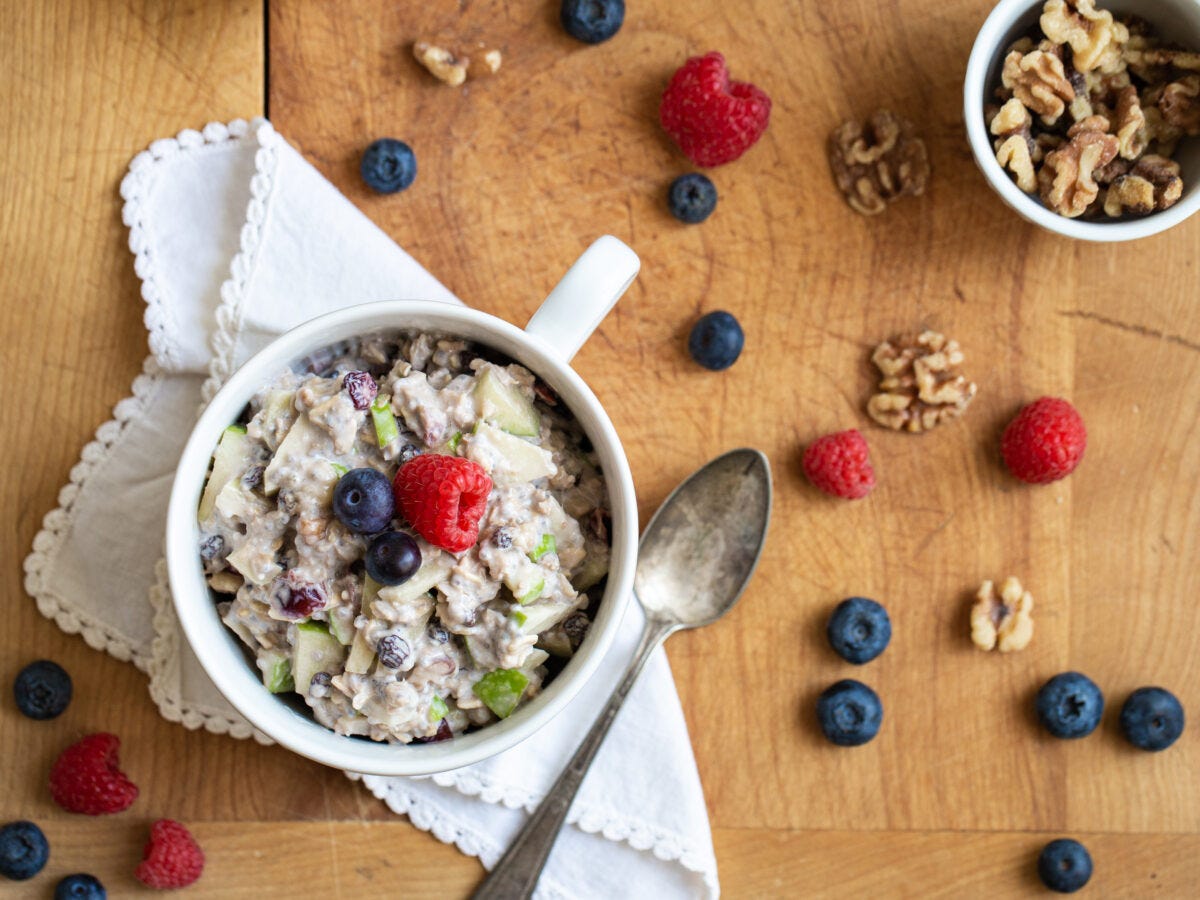
🥗 This rendition of overnight oats can be made the night before so your breakfast is waiting for you in the refrigerator when you’re ready to eat in the morning. The overall Nutrivore Score of this Double Berry Swiss Oatmeal is upped by the addition of dried mulberries and currants, as well as fresh mixed berries!
Add this recipe to your meal plan this week with Real Plans, the official Nutrivore meal planning app!
Nutrivore Mindset Corner
🧠Traditional dieting poses risks such as food obsession, cravings, emotional eating, disordered eating, eating disorders, and weight regain cycles (a.k.a. yo-yo dieting). One study showed that 35% of “normal dieters” progress to pathological dieting, with 20 to 25% of those individuals developing eating disorders.
And this is why Nutrivore is different. Nutrivore is about improving diet quality while quitting diet mentality.
First of all, it has a permissive structure—on Nutrivore, there are no foods you have to cut. There are no “good” or “bad” foods, and instead emphasis is placed on the overall quality of the whole diet. We focus on eating more of those foods that supply us with ample nutrition and that are known to improve our health, without depriving ourselves of any food. By doing so, Nutrivore supports a healthy relationship with food, putting an end to restrictive dieting leading to disordered eating.
Second, instead of your health being something to be sacrificed for the sake of a weight loss-centric diet, Nutrivore is all about supplying your body with the nutrients it needs to support health and reduce risk of disease. It’s a balanced approach that fosters sustainability, a way of eating for lifelong health that additionally mends our relationship with our own bodies.
Nutrivore promotes a holistic, lifelong approach to health, emphasizing that individual food choices do not singularly define the success or failure of one’s diet or overall well-being. You can absolutely meet your body’s nutritional needs from the foods you eat while choosing some foods that aren’t particularly nutrient-dense, but are just plain tasty. It’s okay if some of our food choices are centered around joy rather than nutrient density. One food will not make or break your diet, nor make or break your health.
Learn everything you need to know about the Nutrivore philosophy in my book, Nutrivore: Eat Any Food, Get Every Nutrient, and Transform Your Health!
Helpful Tip of the Week
💡Upping fiber intake? Go slow!
The RDA of fiber is 14 grams per 1,000 calories. So, if you eat a 2,000 calorie per day diet, aim for at least 28 grams of fiber. Fiber is one of those “the more, the better” nutrients—for every 10 grams of daily fiber you consume, risk of all-cause mortality decreased by 10%.
That being said, if you’re looking to up your fiber intake, it’s best to do so gradually! This is because a sudden increase in fiber intake can cause a variety of unpleasant symptoms, such as gas, bloating, constipation and diarrhea—your gut microbiome needs time to adjust to your dietary changes.
It’s recommended to step up your fiber intake weekly, giving your digestive tract a full week to adjust to each incremental increase, until you hit your target fiber intake levels—the recommended amount to step up each week is 5 grams per day. So, if you’re starting out at 10 grams of fiber daily, go up to 15 grams for all of next week, the week after go up to 20 grams for the whole week, and the week after that, go up to 25 grams for the whole week. And, if a 5-gram incremental increase causes gastrointestinal symptoms, it’s okay to take smaller steps and give more time between each increase.
It’s also helpful to make sure your fiber is coming from a variety of sources (not all from supplements or fiber-fortified meal replacement products like protein bars) and that you’re incorporating some fermented foods, like sauerkraut, yogurt, kefir and kombucha.
When in doubt, consult your doctor.
Watch & Learn
🎥Check out my YouTube videos on fruit and vegetables as sources of fiber and carbohydrates, and the highest fiber recipes I analyzed last week! And don’t forget to subscribe and hit bell notifications, so you never miss a new video!
This Week’s Downloads
📥For paid subscribers, your downloads this week are:
Top 10 Fiber Foods Fridge List - This 1-pager PDF guide lists the top 10 common whole food sources of fiber, how much fiber you get per serving (and how much a serving is!), while highlighting a few other valuable nutrients each food provides.
Double Berry Swiss Oatmeal Recipe - A beautifully-designed PDF version of this week’s recipe that you can save or print out, to build your own personalized Nutrivore Cookbook week by week.
You can find buttons to download at the bottom of this Substack. Thank you so much for supporting my work and Nutrivore!
Sincerely,
Dr. Sarah Ballantyne, PhD
Founder of Nutrivore
Medical Disclaimer: The information provided in this Substack is for educational purposes only and is not intended as a substitute for professional medical advice, diagnosis, or treatment. Always seek the advice of your physician or another qualified healthcare provider with any questions you may have regarding a medical condition or dietary changes.
FTC Disclosure: Some links in this Substack may be affiliate links, meaning I may earn a small commission if you purchase through them at no additional cost to you. I only recommend products I genuinely believe in. Thank you for supporting my work!
