

👉This week, we’re talking about: selenium’s potential role in lowering cardiovascular disease risk; oysters as one of the most nutrient-dense foods we can possibly choose; how the selenium in seafood protects against methylmercury (and the minority of times when we do need to worry); how to protect ourselves from food fear-mongering on the internet; and I’m sharing my decadent recipe for Oysters on the Half Shell!
Key Takeaways
✅Selenium has been shown to reduce the risk of heart disease in several observational studies.
✅Oysters are an amazing source of so many nutrients, including selenium. They give liver a run for its money!
✅Almost all seafood options are safe to consume from a mercury standpoint, thanks to selenium!
✅For paid subscribers, your companion downloads this week are: Nutrients in Seafood and Oysters on the Half Shell. Check your inbox; they’ll be arriving in a separate email (or if you use the Substack app, they’ll be in their own post).
Selenium for Cardiovascular Disease
🧬Selenium is a very unique nutrient. It serves as a component of the non-proteinogenic amino acids selenocysteine and selenomethionine, and also helps form over two dozen selenoproteins involved in reproduction, thyroid hormone metabolism, antioxidant defense, DNA synthesis, and immunity. It also helps protect against oxidative damage and (one of the coolest properties, in my opinion) it protects against mercury toxicity!! That said, it is one of the nutrients that you can get too much of, so being aware of your selenium sources is never a bad idea!
There is evidence suggesting selenium could help protect against heart disease. Across numerous observational studies, higher selenium status (as measured by blood selenium concentrations) has been associated with a significantly lower risk of developing cardiovascular disease. One meta-analysis showed a 15% risk reduction for every 10 mcg increase in blood levels. But, randomized controlled trials haven’t shown a consistent benefit for selenium supplementation on heart disease during long-term follow ups. So, it’s unclear whether these observational trends are due to dietary selenium intake or other diet, lifestyle, or genetic factors but more study would help to determine if there is a true link.
Want to know the top 25 best food sources of selenium? Learn them here.
Get 161% DV Selenium with Oysters
🐟Pacific oysters have an impressive Nutrivore Score of 2255! Not only are oysters tasty, they are great for the environment too! These creatures are filter feeders with studies showing individual oysters are capable of filtering up to 50 gallons (189 liters) of water per day! This is why oyster reefs are gaining popularity as a means to restore ecosystems—by improving water quality, eliminating pollutants and providing habitats for hundreds of animals.
Per serving (4 ounces, measured raw), Pacific oysters offer 790mg of omega-3 fats, 767% DV vitamin B12, 201% DV copper, 174% DV zinc, 161% DV selenium, 157% DV vitamin B7 (biotin), 48% DV iodine, 33% DV iron, 32% DV manganese, and 21% DV vitamin B2 (riboflavin). Whew, that’s a lot of nutrients just from one small mollusk!
In fact, oysters give liver a run for its money in terms of nutrient density! (And oysters have a very similar nutrient profile, so a great option if liver is not your thing.) While fresh oysters are an decadent experience (see my recipe for Oysters on the Half Shell below), you get the same nutritional benefits however you enjoy them, including cooked from frozen or canned (which are definitely the most affordable options)!
Pacific oysters are the 59th most nutrient-dense food! Learn the Top 500 Nutrivore Foods here.
Oysters on the Half Shell
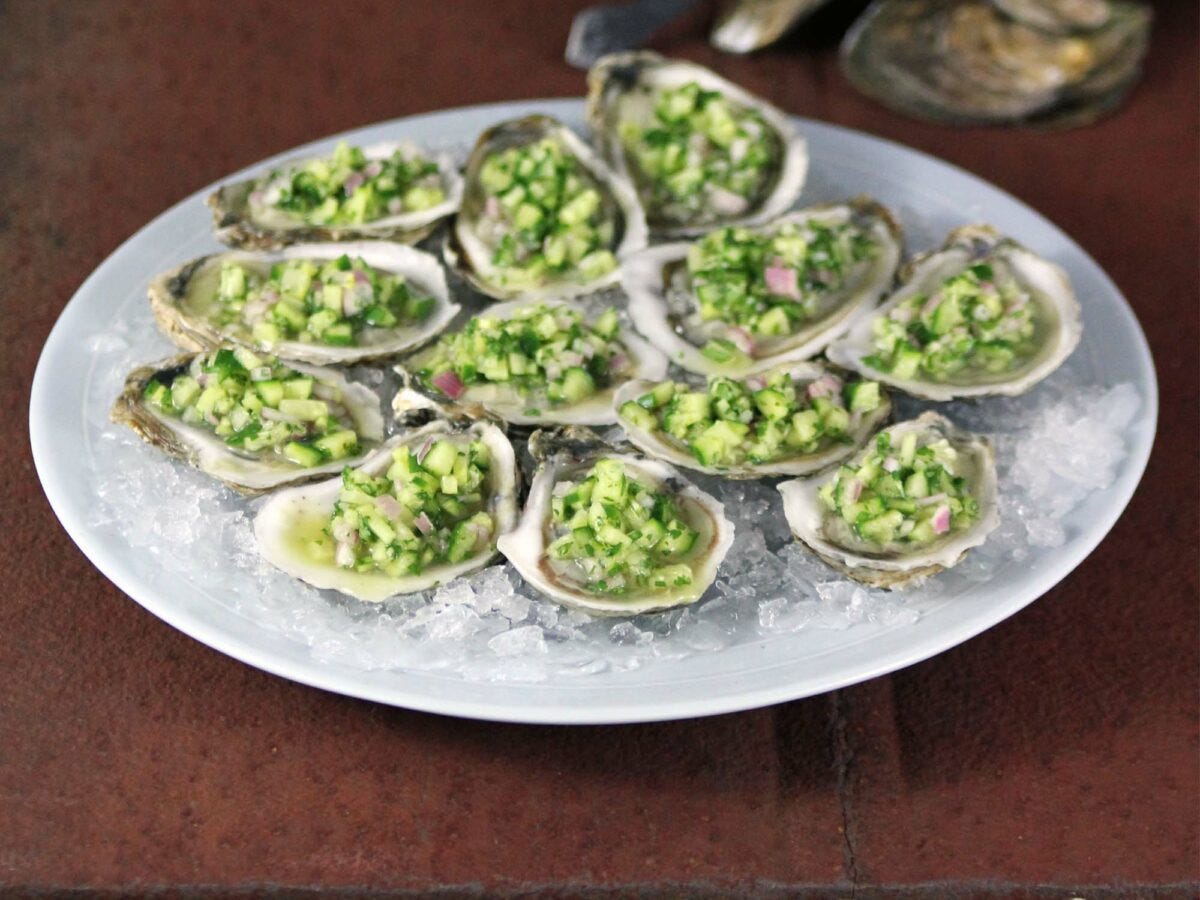
🥗 There is nothing more delicious and fresh than the cool and juicy bite of a freshly shucked oyster! I love making this cucumber slaw for my oysters as it marinades in the fridge and adds a further tangy and fresh bite that just leaves you wanting more and more! Start off your summer patio BBQ with this refreshing appetizer, or bring to a potluck and be the talk of the party. Just remember to pack extra ice!
Add this recipe to your meal plan this week with Real Plans, the official Nutrivore meal planning app!
Nutrivore Mindset Corner
🧠Whenever I talk about the benefits of seafood, I invariably get asked “what about the mercury???”, or similar question about PCBs, dioxins, lead, radioactive isotopes, microplastics, forever chemicals, food dyes, fish farms, bottom feeders, and sustainability/overfishing. I want to first honor that pollution concerns are absolutely valid and I support efforts to reduce pollution, protect the environment and ecosystems, and sustainable fishing practices. I also think that seafood wins in terms of the shear amount of misconceptions and misinformation about it. That’s why busting seafood-related myths take up such a big fraction of Chapter 10 in my book Nutrivore and why I address mercury concerns below. Here, in our little mindset corner though, I want to talk about the prevalence of food fear mongering on the internet, and what we can do to help protect ourselves.
Fear gets clicks, and dramatic claims spread much faster than nuanced science. Whenever you encounter a scary nutrition claim online, try to get curious instead of getting anxious. Ask yourself: Are citations to support claims being provided? Is this based on evidence in humans? Is the risk being put into perspective? Is the dose associated with the risk explained? Does this advice encourage me to eat a wider variety of nutrient-dense foods, or does it unnecessarily eliminate them? Does this advice sound like diet culture or does it encourage a balanced mindset?
It can also help to look at who is making the claim. Do they have relevant credentials or expertise in nutrition or health science? Are they citing credible sources, or relying on anecdotes and dramatic language? And importantly, are they trying to sell you something—like a supplement, detox, or more expensive alternative—as the “solution” to the problem they’re describing? A little healthy skepticism can go a long way toward protecting both your peace of mind and your relationship with food.
At the end of the day, there’s no one single red flag that automatically identifies an influencer or health claim as untrustworthy. Instead, watch for the collection of yellow flags. They can help you decide whether a claim deserves your mental or emotional energy, or whether it’s best to scroll on.
Learn everything you need to know about the Nutrivore philosophy in my book, Nutrivore: Eat Any Food, Get Every Nutrient, and Transform Your Health!
Helpful Tip of the Week
💡What about the mercury in seafood? Amidst the many health benefits of seafood is one well-publicized risk: potential contamination with an organic form of mercury called methylmercury (as well as other toxins, such as PCBs and dioxins). In fact, pregnant women are advised to limit seafood consumption to just two 6-oz servings per week over fears that mercury will cause brain damage to the developing fetus. But, are these concerns based on sound science?
It turns out, there’s more to the story than meets the eye! The high micronutrient content of seafood comes to the rescue here—specifically, the trace mineral selenium. Among selenium’s many roles is an ability to bind irreversibly with mercury, in turn reducing its absorption and preventing its harmful effects in our bodies. In fact, the selenium in seafood can help protect us from mercury exposure from other sources beyond the seafood itself!
The only exceptions to this rule are the top-predator fish from contaminated waters, in which the methylmercury accumulation is higher than their selenium content. Mercury levels in these fish can be quite high not only due to absorbing mercury from the water, but also from biomagnification, where mercury accumulates from the organisms that these fish consume. Luckily, the list here is fairly short: fish with potentially unsafe mercury levels are king mackerel, marlin, pilot whale, shark, tarpin, tilefish, and swordfish (although some studies show that swordfish is okay!).
What’s more, the majority of commonly eaten seafood is actually quite low in methylmercury to begin with. The vast majority of ocean fish and approximately 97% of fresh water fish are low in mercury and/or contain enough selenium to protect against its effects. Extremely safe seafood varieties include shellfish (including oysters, clams, scallops, mussels, crab, shrimp, and lobster), anchovies, salmon, trout, herring, haddock, pollock (Boston bluefish), sole, flounder, Atlantic mackerel, and lake whitefish.
Ultimately, increasing your dietary intake of selenium is a great way to protect yourself from mercury exposure from food sources or from environmental factors. Along with seafood and seaweed, selenium is abundant in Brazil nuts, mushrooms, onions, sunflower seeds, and meat and poultry (especially the liver!).
This Week’s Companion Downloads
📥For paid subscribers, your Companion Downloads this week are:
Nutrients in Seafood - This 1-pager PDF guide highlights key nutrients in seafood and their benefits, to give you a quick-reference for why three or more weekly servings of seafood (either fish or shellfish) is so good for you.
Oysters on the Half Shell Recipe - A beautifully-designed PDF version of this week’s recipe that you can save or print out, to build your own personalized Nutrivore Cookbook week by week.
Check your inbox for the Companion Downloads arriving in a separate email (or if you use the Substack app, they’ll be in their own post). You can also find them in the archive here. Thank you so much for supporting my work and Nutrivore!
Sincerely,
Dr. Sarah Ballantyne, PhD
Founder of Nutrivore