

👉This week, we’re talking about: quercetin as an anti-inflammatory polyphenol; pistachios as a good source of quercetin plus more; why adding flavoring ingredients to salad both increases nutrient absorption and helps support our healthy habits; the best way to store pistachios, how to log your starting point before a sustainable health journey, and I’m sharing my Fig and Pistachio Salad recipe.1
Key Takeaways
✅Quercetin lowers C-reactive protein in people with diagnosed chronic diseases and/or metabolic syndrome.
✅The best way to store pistachios if you aren’t going to nom them in the next couple of weeks is in the freezer! Plus, you can actually eat them frozen!
✅Adding flavor to your salad is a good strategy both for enhancing nutrient absorption and for supporting healthy habit formation!
✅For paid subscribers, your downloads this week are: Top 10 Polyphenol Foods Fridge List and Fig and Pistachio Salad.
Quercetin for Inflammation
🧬Quercetin is one of the most well-studied polyphenol and is frequently sold as a supplement, although it’s also widely distributed in foods (in fact, it’s the most abundant dietary flavonoid polyphenols). Across a variety of studies, quercetin demonstrates significant antioxidant, anti-inflammatory, anti-aging, and cardioprotective properties. For example, in a 28-year follow-up study of 10,000 individuals, a quercetin intake of greater than 4 mg daily—about what you would get if you ate an apple per day—was associated with a significant 21% reduction in cardiovascular disease mortality.
One of the better-studied benefits of quercetin is lowering inflammation (specifically, a marker of inflammation called C-reactive protein) in people with chronic disease diagnoses and/or metabolic syndrome. (People with metabolic syndrome also get an LDL-cholesterol-lowering benefit from quercetin.) And while we still need clinical trials to confirm benefits in humans, animal model studies show the anti-inflammatory effects of quercetin could benefit osteoarthritis and inflammatory skin conditions.
In addition to benefiting us directly, quercetin is metabolized by our gut bacteria into a variety of beneficial organic acids including: phenylacetic acid, hydroxyphenyl-acetic acid, and protocatechuic acid. This is a rationale for sticking with food sources of quercetin, since the fiber they contain helps to improve gut microbiome composition and metabolic activity.
Quercetin is particularly rich in tea, cranberries, pistachios, beans, buckwheat, apples, red and yellow onions, asparagus, kale, spinach, lettuce, cherries, and broccoli.
Want to know the top 25 best food sources of polyphenols? Learn them here.
Get 464 mg Polyphenols with Pistachios
Pistachios are an amazing source of polyphenols in general, including being abundant in quercetin. With their impressive Nutrivore Score of 265, they also deliver 48% DV vitamin E, 40% DV copper, 30% DV biotin, 28% DV vitamin B6, 20% DV vitamin B1, 6.5 grams of monounsaturated fats and 3.9 grams of linoleic acid in a 1-ounce serving!
And, fun fact: When stored improperly in bulk containers, pistachios have been known to spontaneously combust, causing fires! Not to worry though as this phenomenon occurs with nuts stored in bulk containers and is not a concern in your kitchen pantry!
Pistachios are the 376th most nutrient-dense food! Learn the Top 500 Nutrivore Foods here.
Fig and Pistachio Salad
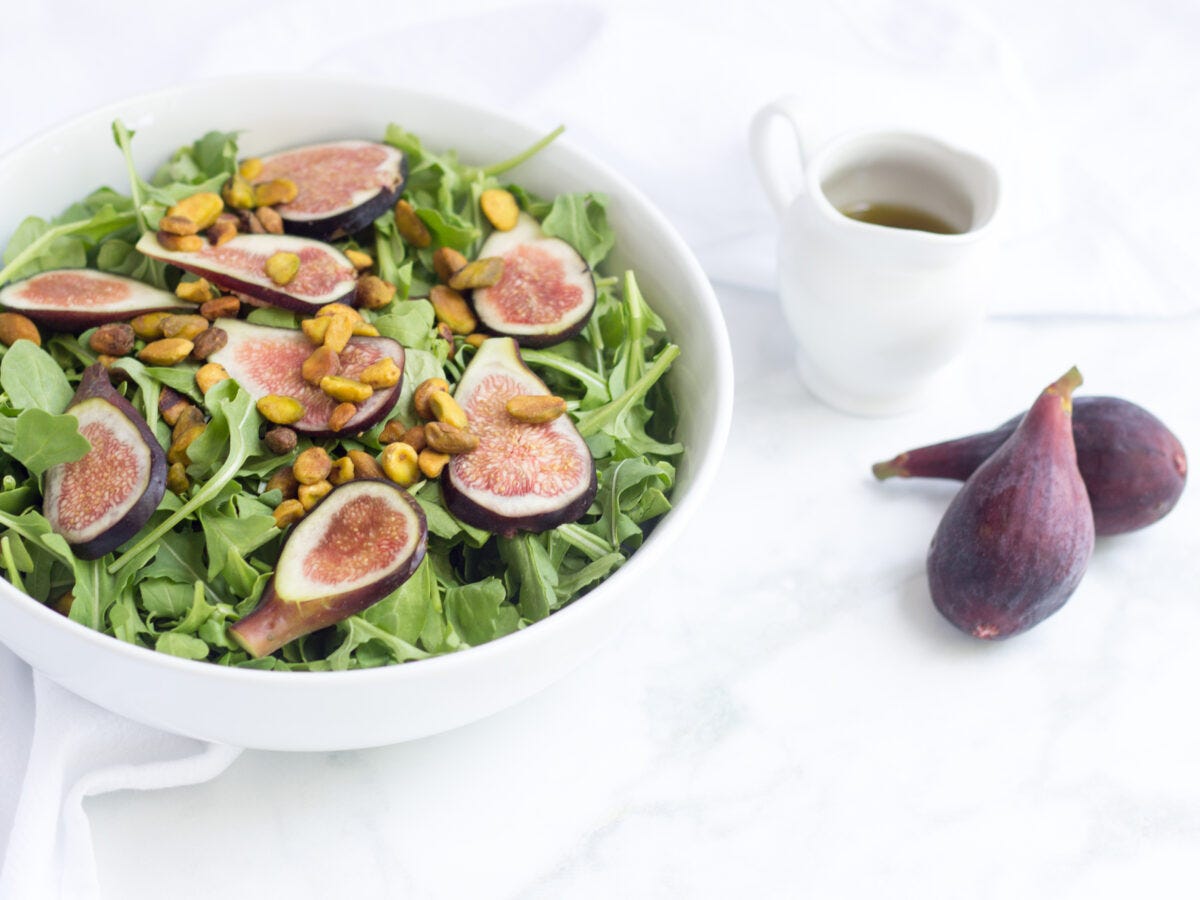
🥗 This Fig and Pistachio Salad is the perfect combination of sweet fruit, crunchy nut and peppery green with a tangy dressing. The arugula can be subbed for any peppery green; arugula, turnip greens, and mustard greens work really well. Or use the leafy greens of your choosing! Crumbled goat cheese is also a wonderful addition to this salad.
Add this recipe to your meal plan this week with Real Plans, the official Nutrivore meal planning app!
Nutrivore Mindset Corner
🧠Since I’m sharing a salad recipe this week, let’s talk about the awful message from diet culture that tells us that if we add ingredients to our salad to make it taste good, it somehow doesn’t count.
Leafy greens, such as spinach, kale, collards, and Swiss chard, are among the most nutrient-dense foods available, providing an abundance of vitamins A, C, and K, folate, magnesium, and fiber. They are particularly high in chlorophyll, which has antioxidant and anti-inflammatory properties, as well as carotenoids like lutein and zeaxanthin, which protect eye health. Research has consistently linked high leafy green consumption (ideally daily) to improved cardiovascular health, reduced cognitive decline, and lower risks of diabetes, osteoporosis, and certain cancers.
Many of the beneficial nutrients in leafy veggies are fat-soluble, which means your body absorbs them better when fat is present. Adding olive oil, avocado, nuts, seeds, cheese, or even a creamy dressing doesn’t cancel out the benefits of the greens—it actually helps unlock them. In other words, a salad with fat isn’t “less healthy”; it’s often more nourishing because your body can use more of what’s there.
There’s also the reality of human behavior. If a salad feels like a chore—dry, bland, or flavorless—it’s not likely to become a habit. Ingredients that add flavor, texture, and satisfaction make salads something you want to eat, not something you force yourself to tolerate. And from a Nutrivore perspective, anything that supports consistency matters. A salad you enjoy several times a week delivers far more nutritional benefit over time than a “perfect” salad you avoid altogether.
Most importantly, adding enjoyable ingredients helps shift the mindset away from restriction and toward nourishment. When salads are flavorful and satisfying, they support both nutrient sufficiency and a positive relationship with food. That combination—nutrients plus sustainability—is what makes habits stick, and that’s where real health benefits are built.
Learn everything you need to know about the Nutrivore philosophy in my book, Nutrivore: Eat Any Food, Get Every Nutrient, and Transform Your Health!
Helpful Tip of the Week
💡Like other nuts pistachios can go rancid if not stored properly. After you’ve opened the package, for short-term storage—up to a few weeks—keep pistachios in an airtight container (which could be as simply as tying a twist tie around the package opening) in a cool, dark place like a cupboard or pantry.
For longer-term storage, the refrigerator or freezer is the best option. Stored in an airtight container, pistachios will keep well in the refrigerator for several months and in the freezer for up to a year or more. Freezing does not harm their texture, and they can be eaten straight from the freezer or allowed to come to room temperature in just a few minutes.
No matter where you store them, minimizing air exposure is key. Reseal bags tightly or transfer pistachios to containers with a secure lid, and avoid storing them near strong-smelling foods (like onions) since nuts can absorb odors. If pistachios develop a bitter or paint-like smell, that’s a sign the fats have oxidized and it’s time to discard them.
Watch & Learn
🎥Check out my YouTube videos on how to document your starting point before working on healthy habits and why nuts and seeds are a Nutrivore foundational food! And don’t forget to subscribe and hit bell notifications, so you never miss a new video!
This Week’s Downloads
📥For paid subscribers, your downloads this week are:
Top 10 Polyphenol Foods Fridge List - This 1-pager PDF guide lists the top 10 common food sources of polyphenols, how much polyphenols you get per serving (and how much a serving is!), while highlighting a few other valuable nutrients each food provides.
Fig and Pistachio Salad Recipe - A beautifully-designed PDF version of this week’s recipe that you can save or print out, to build your own personalized Nutrivore Cookbook week by week.
You can find buttons to download at the bottom of this Substack. Thank you so much for supporting my work and Nutrivore!
Sincerely,
Dr. Sarah Ballantyne, PhD
Founder of Nutrivore
Medical Disclaimer: The information provided in this Substack is for educational purposes only and is not intended as a substitute for professional medical advice, diagnosis, or treatment. Always seek the advice of your physician or another qualified healthcare provider with any questions you may have regarding a medical condition or dietary changes.
FTC Disclosure: Some links in this Substack may be affiliate links, meaning I may earn a small commission if you purchase through them at no additional cost to you. I only recommend products I genuinely believe in. Thank you for supporting my work!
