

👉This week, we’re talking about: CoenzymeQ10 as a beneficial nutrient for people with chronic fatigue; grapes as the fourth best food source of CoQ10 (which I think is way cooler than resveratrol); why it’s helpful to to focus on habits instead of food rules; how to build healthier habits step by step; and I’m sharing my simple Roasted Grapes recipe, a perfect side dish for fish or addition to your charcuterie board.
Key Takeaways
✅Coenzyme Q10 is a fascinating nutrient with a ton of health benefits, including improving chronic fatigue. And one of the best food sources is grapes!
✅Ever heard of Roasted Grapes? Well now you have, and I promise you will be blown away!
✅When life gets hectic, we fall back on habits, whether good or bad. This is both why bad habits can undermine our ability to progress towards a goal and why good habits can keep us on track.
✅For paid subscribers, your companion downloads this week are: Nutrients for Fatigue and Roasted Grapes. Check your inbox; they’ll be arriving in a separate email (or if you use the Substack app, they’ll be in their own post).
CoQ10 for Chronic Fatigue
🧬Coenzyme Q10, or as it’s more commonly called, CoQ10, is a super interesting and helpful nutrient. One of its most important roles is in participating in cellular respiration to generate adenosine triphosphate (ATP)—also known as the “energy currency” of cells! The organs in our body which have the highest energy requirements have the highest concentration of this nutrient: heart, liver, pancreas, and kidney. CoQ10 is also an important part of the body’s endogenous antioxidant system.
There’s growing evidence that may be helpful for chronic fatigue. CoQ10 A 2021 randomized, double-blind, placebo-controlled trial found that among patients with myalgic encephalomyelitis/chronic fatigue syndrome (ME/CFS), 12 weeks of supplementing with 200mg CoQ10 each day (combined with 20mg daily of NADH, the reduced form of nicotinamide adenine dinucleotide) led to significant improvements in cognitive fatigue perception, fatigue impact scale scores, health-related quality of life, and sleep duration. A 2009 analysis also found that chronic fatigue patients had significantly lower levels of plasma CoQ10 relative to healthy controls: up to 44.8% of patients had CoQ10 values beneath the lowest plasma CoQ10 value measured among in the controls. In addition, there were significant inverse relationships between CoQ10 and FibroFatigue (FF) scale scores, fatigue, and autonomic symptoms. Chronic fatigue patients with very low CoQ10 levels also had significantly more concentration and memory disturbances!
The best sources of CoQ10 are oily fish (including salmon, mackerel, yellowtail, trout, and sardines), organ meats (especially heart, liver, and kidney), beef, chicken, pork, and grapes. It’s also found in smaller amounts in Brassica vegetables like broccoli, legumes, peanuts, nuts (especially pistachios, walnuts, and hazelnuts), and seeds.
Want to know the top 25 best food sources of this CoQ10? Learn them here.
Get 7.7mg CoQ10 with Grapes
🍇Grapes are famous for their resveratrol content, which has benefits for cancer prevention, cardio-protective effects, neuro-protective effects, diabetes, liver disease, obesity, Alzheimer’s disease and Parkinson’s disease. But, I would argue that the far more interesting nutrient in grapes is Coenzyme Q10! Grapes are the fourth highest common food source of CoQ10, containing almost as much per serving as liver! Given that higher intake/levels of CoQ10 are associated with lower risk of over two dozen health problems (take that, resveratrol), I think that’s even more reason to enjoy grapes on a regular basis!
Grapes are the 373rd most nutrient-dense food! Learn the Top 500 Nutrivore Foods here.
Roasted Grapes Recipe
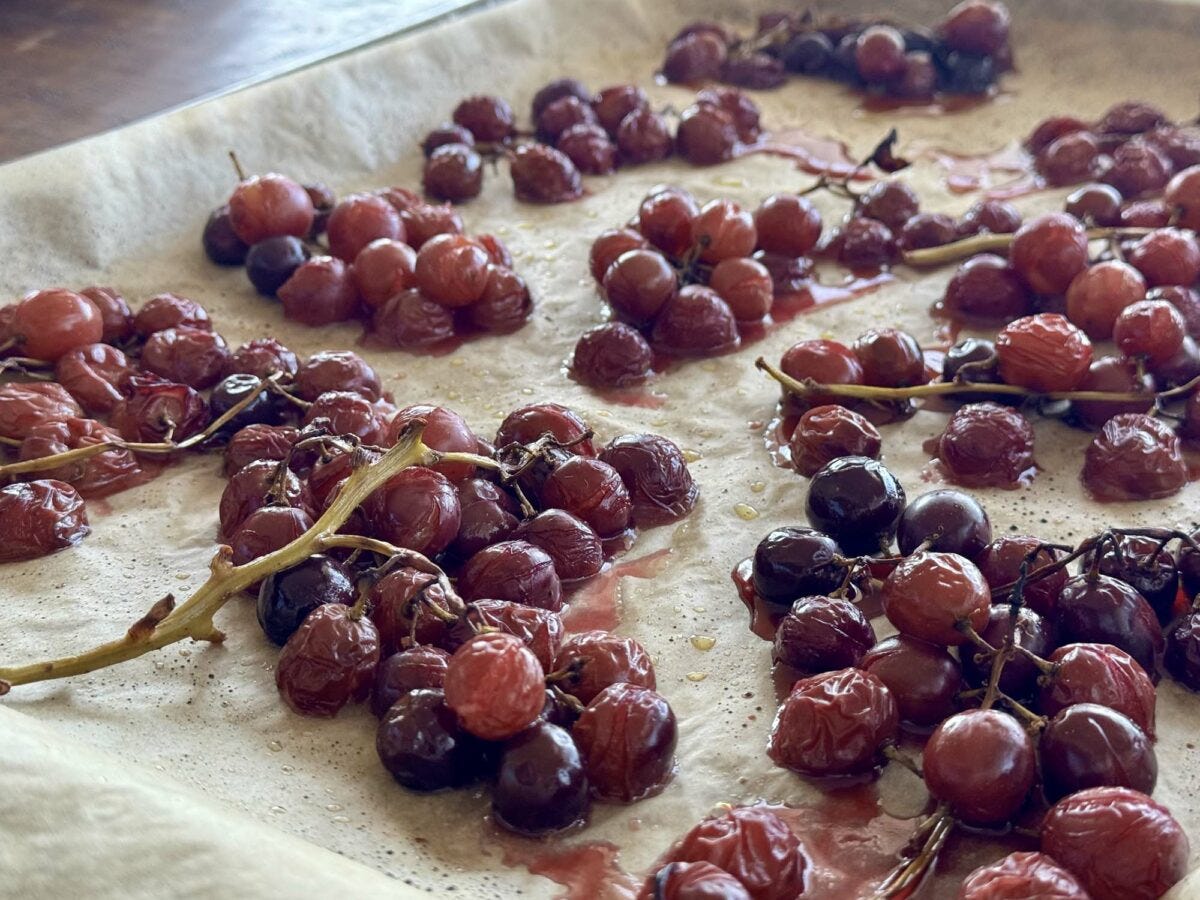
🥗 Roasted what?! Yes, that’s right. Go with me here: imagine how juicy, sweet and cool it is biting into your favorite large grape. Now take those juicy, sweet fruit bunches and imagine the sugars and juice roasting in a pan for 20 minutes reducing the liquid and concentrating the flavor of these gems. Have I convinced you? Now add in the fact that you are getting some top-tier nutrients from this indulgence and you have the perfect new favorite food!
Roasted grapes can be used in so many ways including a side dish with some delicate fish (how elegant would a pan-fried halibut feel with these on the side?), as a condiment on top of a bbq’d pork tenderloin, a soft and sweet salad topper, or add them to your charcuterie board to jazz up the spread for your next event!
Add this recipe to your meal plan this week with Real Plans, the official Nutrivore meal planning app!
Nutrivore Mindset Corner
🧠As we enter the holiday season, let’s shift away from the food guilt, diet pressure, rules, and rebellion, and instead focus on habits.
About 40% of the day-to-day actions we take aren’t goal-directed behaviors (i.e., conscious decisions), but rather are behaviors driven by stimulus-response associations that are performed automatically requiring no conscious thought, i.e., habits. And, when a goal conflicts with a habit—for example, a goal to eat a whole-foods diet conflicting with a habit of eating junk food in front of the TV in the evening—that’s where achieving the goal requires that dreaded word… willpower. It takes a huge amount of effort to not do something that we normally do completely unconsciously in response to a stimulus as simple as our environment. And, as soon as we aren’t paying attention, we revert to our habitual behavior, undermining our progress towards our goal without even thinking about it!
When we are distracted, stress, anxious, or tired, we fall back on habits, whether good or bad. This is both why bad habits can undermine our ability to progress towards a goal and why good habits can keep us on track—without the need for willpower or self-control—even when life gets overwhelming. So, instead of fighting a powerful form of learning, think about the good habits you can form to ditch the on-again-off-again cycle for good.
In fact, studies have shown that people who are score highly in measures of self-control don’t actually achieve their goals because of exerting that self-control. Rather, these people are highly effective at forming good habits that contribute to successful outcomes!
So, this holiday season, think about one simple healthy habit to focus on, maybe that’s adding an extra serving of veggies per day, a daily morning walk, or an earlier bedtime. Let that be the focus instead of engaging with the diet rollercoaster.
Learn everything you need to know about the Nutrivore philosophy in my book, Nutrivore: Eat Any Food, Get Every Nutrient, and Transform Your Health!
Helpful Tip of the Week
💡How do you form a habit? The following protocol comes from a 2012 paper offering guidance to physicians to help improve their patient’s health by focusing on habit formation.
Decide on a goal that you would like to achieve for your health.
Choose a simple action that will get you towards your goal which you can do on a daily basis.
Plan when and where you will do your chosen action. Be consistent: choose a time and place that you encounter every day of the week.
Every time you encounter that time and place, do the action.
It will get easier with time, and eventually you should find you are doing it automatically without even having to think about it.
Congratulations, you’ve made a healthy habit!
How long is eventually in this context? Unfortunately, it’s a myth that it takes 21 days to make or break a habit. For the vast majority of us, it takes dedication and commitment to repetitively perform a task for a much greater length of time before that task becomes automatic.
In fact, research shows that the average length of time it takes to form a new habit is 66 days, but that the time required for form a habit varies from 18 days to 254 days (about 8 months)!!!! This likely varies from person to person, but also by type of habit and the individual challenges each of us face to making a specific change. Chances are good that if it’s a habit you’ve unsuccessfully tried to create before, it’s going to take a longer amount of time to get it right this time.
And if you’d appreciate a structure program with a healthy habit focus, I have two awesome options for you:
Nutrivore Salad-a-Day Challenge E-Book - 50+ recipes, 10 handy visual guides and food lists like my Nutrivore Salad Matrix, great for a simple and delicious single habit focus
Nutrivore90 Online Course - 15 downloadable PDF guides, weekly and daily tracking sheets, 100+ daily videos, great as a comprehensive habit-centered nutrition on-ramp program with a new (customizable) focus layered each week
This Week’s Companion Downloads
📥For paid subscribers, your Companion Downloads this week are:
Nutrients for Chronic Fatigue - This 1-pager PDF guide lists all the nutrients that reduce risk or severity of pathological fatigue and chronic fatigue along with top food sources, to give you a quick-reference for foods to add if fatigue is a concern for you.
Roasted Grapes Recipe - A beautifully-designed PDF version of this week’s recipe that you can save or print out, to build your own personalized Nutrivore Cookbook week by week.
Check your inbox for the Companion Downloads arriving in a separate email (or if you use the Substack app, they’ll be in their own post). You can also find them in the archive here. Thank you so much for supporting my work and Nutrivore!
Sincerely,
Dr. Sarah Ballantyne, PhD
Founder of Nutrivore