

👉This week, we’re talking about: how the betalains in beets improve muscle recovery and exercise performance, what makes beets the most nutrient-dense root vegetable, the cool science behind why you may like my Balsamic Roasted Beets recipe even if you don’t like beets, how to grow beets if you’re a first-time gardener, and my tips for New Year’s Resolutions that stick.1
Key Takeaways
✅If exercise is one of your New Year’s resolutions, you’ll be interested to know that beets can help improve exercise performance.
✅If you hate beets, there’s cool science behind why you might like my Balsamic Roasted Beets recipe!
✅The key to New Year’s Resolutions that stick is to ditch the reset mentality and embrace baby steps! (Plus joining the Nutrivore90 Challenge, all about habit stacking and small wins!)
✅For paid subscribers, your downloads this week are: Nutrients in Root Vegetables and Balsamic Roasted Beets
Betalains for Muscle Recovery
🧬Betalains are a class of phytonutrients found in only a few plants—beets are the best source, but you can also find betalains in chard, amaranth, prickly pear, dragon fruit, and some species of wild mushrooms. And, betalains improve endurance, performance and exercise recovery!
For example, a double-blind, cross-over design study in triathletes showed that taking a betalain-rich concentrate of beetroots (or a control) for a week helped them run a 10K faster, even though there was no change to average heart rate or perceived exertion. And, when the athletes came back the following day to test recovery by running a 5K, they still ran faster and had lower levels of markers of muscle damage and lower subjective fatigue. Similar results have been found in recreational runners and cyclists, some types of high-intensity interval training, and untrained walkers—so you don’t already need to be in shape to benefit from betalains!
Betalains can also help you kill it at the gym. In a recent study of physically active women, taking a single 2-ounce shot of beetroot juice two and a half hours before a back squat test improved velocity and power—the women also jumped higher in a countermovement jump test. And in a similar study of healthy men, a shot of beetroot juice taken two hours before resistance training helped them get more reps per set of back squats.
Want to know the top food sources of betalains? Learn them here.
Get 246 mg Betalains with Beets
Beets are the single most nutrient-dense root vegetable with their Nutrivore Score of 2013, thanks in part to being the most concentrated source of betalains. A 1-cup serving of raw beets (or about ¾ cup if boiled) also delivers 37% DV folate, 19% DV manganese, 11% DV copper, 9% DV potassium, and an impressive 326 milligrams of polyphenols and 3.8 grams of fiber–all for just 58 calories!
Beets are the 37th most nutrient-dense food! Learn the Top 500 Nutrivore Foods here.
Balsamic Roasted Beets Recipe
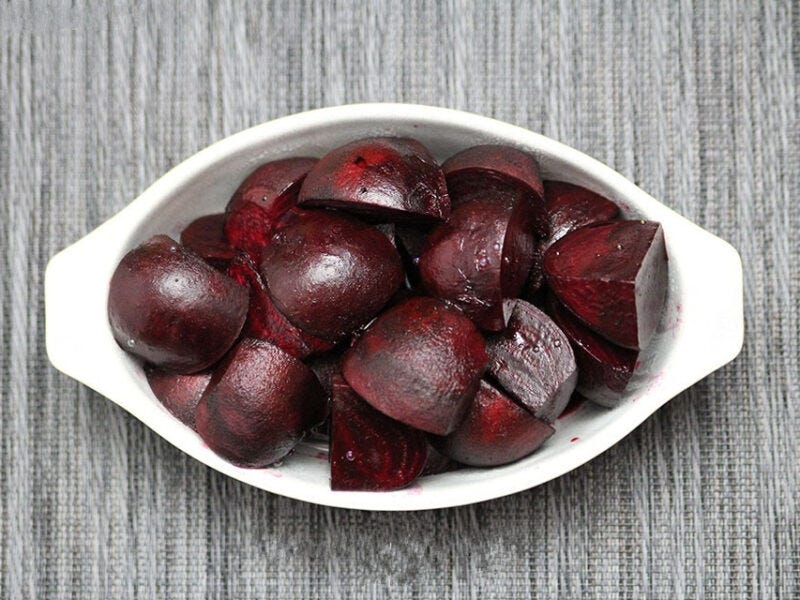
🥗 If you hate the earthy taste of beets it may be because you’re particularly sensitive to geosmin, the compound in beets responsible for this flavor. To overcome this disklike, choose varieties with lower levels of geosmin (like golden beets), or prepare beets in ways to help mask the undesirable taste, such as this recipe! It has also been shown that reaction of geosmin with acid results in an odorless product (argosmin), which is why pairing beets with acidic balsamic vinegar helps to eliminate the earthy flavor!
This is one of my absolute favorite ways to enjoy beets. There’s something about the sweet versus sour combination of balsamic vinegar and roasted beets, and the milder beet flavor, that’s absolutely divine!
Add this recipe to your meal plan this week with Real Plans, the official Nutrivore meal planning app!
Nutrivore Mindset Corner
🧠A brand‑new year can feel like an invitation to reinvent everything at once. Diet culture loves this moment—pushing resets, detoxes, and rigid challenges that leave us feeling defeated by February. But real, lasting change doesn’t come from overhauling your life overnight. It comes from the small habits you practice with consistency and compassion, and that you build upon, baby step by baby step.
This year, instead of aiming for perfection, aim for nourishment. Choose goals that add to your life rather than take things away. Maybe that means learning one new vegetable recipe to add to your regular rotation. Maybe it means adding a piece of fruit to your morning routine, or making sure to eat breakfast daily. Maybe it’s simply sitting down to a balanced home-cooked meal a few times per week.
When you root your goals in self‑care rather than self‑control, your habits become easier, gentler, and more sustainable. And remember: every nourishing choice counts.
And if you’d like some structure and guidance to build healthier eating habits that finally stick this year, come join my FREE 3-month habit-centered nutrition challenge, the Nutrivore90 Challenge, which starts Monday! We will gently layer one habit focus each week to improve diet quality while quitting diet mentality.

Plus, you can learn everything you need to know about the Nutrivore philosophy in my book, Nutrivore: Eat Any Food, Get Every Nutrient, and Transform Your Health!
Helpful Tip of the Week
💡Beets are one of the easiest veggies to grow making them perfect for first time gardeners. This root veggie thrives in cooler weather, comes in a variety of shapes and colors, and is entirely edible – from the sweet roots to the nutritious leafy tops.
Beets actually grow very easily from seed, with one seed often yielding up to four beets! (You can let them grow in a cluster, but they’ll grow bigger if you thin them out once you start to see the beetroot forming at the surface of the soil.) They don’t need anything special in terms of soil and, in fact, fertilizing them will cause the leaves to grow more than the root! They prefer full sun but will tolerate part shade, ideally getting 6 hours of sunlight per day.
Beets are a cool season crop, but fairly tolerant to both frosts and high temperatures. They thrive when the days are warm (60 to 70 °F / 15 to 21 °C) and nights are cool (50 to 60 °F / 10 to 15 °C). So for most zones, plant them in spring or fall—even in pots if you’re tight on space!
Watch & Learn
🎥Check out my YouTube videos on why baby steps work even when they don’t feel big enough, and why beets taste like dirt to some people! And don’t forget to subscribe and hit bell notifications, so you never miss a new video!
This Week’s Downloads
📥For paid subscribers, your downloads this week are:
Nutrients in Root Vegetables - This 1-pager PDF guide highlights key nutrients in root vegetables and their benefits, to give you a quick-reference for why a daily serving of root vegetables (either starchy or non-starchy) is so good for you.
Balsamic Roasted Beets Recipe - A beautifully-designed PDF version of this week’s recipe that you can save or print out, to build your own personalized Nutrivore Cookbook week by week.
You can find buttons to download at the bottom of this Substack. Thank you so much for supporting my work and Nutrivore!
Sincerely,
Dr. Sarah Ballantyne, PhD
Founder of Nutrivore
Medical Disclaimer: The information provided in this Substack is for educational purposes only and is not intended as a substitute for professional medical advice, diagnosis, or treatment. Always seek the advice of your physician or another qualified healthcare provider with any questions you may have regarding a medical condition or dietary changes.
FTC Disclosure: Some links in this Substack may be affiliate links, meaning I may earn a small commission if you purchase through them at no additional cost to you. I only recommend products I genuinely believe in. Thank you for supporting my work!
