

👉This week, we’re talking about: how getting enough potassium lower risk of stroke; why dried apricots have so much more potassium per serving than fresh; why potassium is so hard to get enough of and my tips for getting enough potassium; why I suggest changing focus away from weight loss goals and what to track instead; and I’m sharing my Shaved Brussels Salad recipe.1
Key Takeaways
✅Potassium is one of the most important nutrients to get enough of to lower risk of stroke.
✅It’s really tough to get enough potassium though, so my tips and go-to foods are below!
✅’Tis the season for weight loss resolutions, but I recommend redefining success and looking beyond the scale.
✅For paid subscribers, your downloads this week are: Nutrients for Stroke and Shaved Brussels Salad
Potassium for Stroke Prevention
🧬Several meta-analyses have shown that people who consume more potassium have a significantly lower risk of stroke than those with lower potassium intakes (about a 13 – 30% reduced risk for potassium intakes around 3,500 mg daily or higher). Similarly, observational studies have shown that for every 1-unit increase in the ratio of dietary sodium to potassium (meaning we’re consuming more sodium than potassium), the risk of stroke rises by 22%—emphasizing the importance of keeping these nutrients in proper balance (and suggesting it’s not necessarily high sodium that’s harmful for cardiovascular health, but concurrent low potassium!).
The protective effect of potassium on stroke risk is likely due to its well-established influence on blood pressure. In a large study measuring the sodium to potassium ratio in the urine (a more reliable indicator of intake than dietary recall surveys), people with the highest urinary potassium excretion had 62% lower risk of hypertension than those with the lowest urinary potassium excretion!
Want to know the top 25 best food sources of potassium? Learn them here.
Get 9% DV Potassium with Apricots
🍑While a 1-cup serving of fresh apricots has 9% DV of potassium, a ½-cup serving of dried apricots have 16% DV of potassium, making them one of our best sources of this hard-to-get nutrient!
Why the difference? This really just has to do with how a serving is defined for fresh versus dried fruit, both are actually great sources of potassium, you’re just eating more in a serving when you’re eating dried apricots. So however you like apricots, appreciate them for their potassium… and their copper, vitamin A, vitamin E, carotenoids and polyphenols! They have a Nutrivore Score of 260!
Apricots are the 382nd most nutrient-dense food! Learn the Top 500 Nutrivore Foods here.
Shaved Brussels Salad Recipe
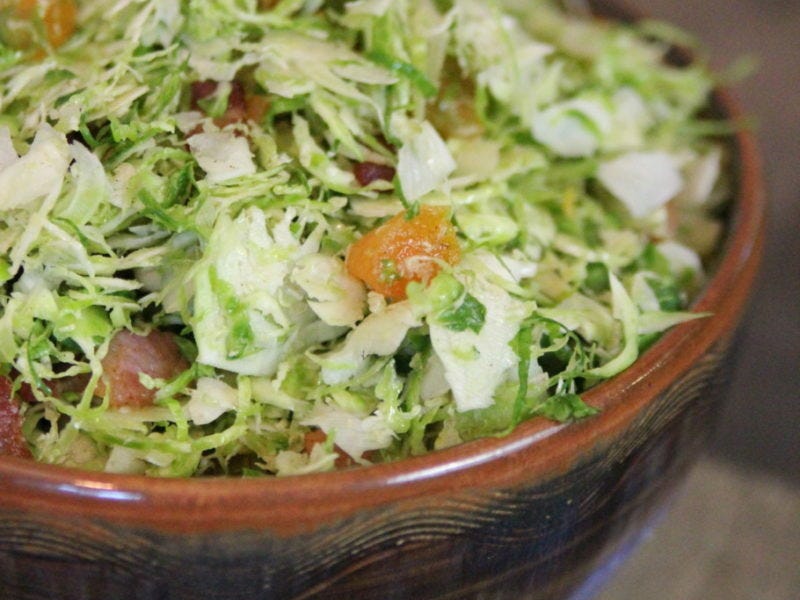
🥗 If you think the only way to enjoy dried apricots is in trail mix, think again! They’re the shining star of this delicious Brussels slaw, and a perfect combination with toasted coconut, bacon and just a hint of cinnamon! In fact, this slaw’s Nutrivore Score is 490, impressive for such a delicious side dish! I particularly like this slaw as a side dish to some grilled pork chops!
Add this recipe to your meal plan this week with Real Plans, the official Nutrivore meal planning app!
Nutrivore Mindset Corner
🧠If you have made a New Year’s Resolution to lose weight, here’s why I suggest shifting that goal away from the scale. Our weight is a very poor proxy for our health, yet so many of us were taught to measure our progress in pounds, as if our wellbeing—or our worth—could ever be captured in a single number. More important than our weight is our diet quality, fitness, sleep patterns, stress levels, and our social and physical environments. More insightful than the number on the scale is our blood pressure, cholesterol, hemoglobin A1C, and how we actually feel. (More options of health markers to track are included in my YouTube video below.)
My suggestion is to focus on healthy habits: a nutritious diet paired with a balanced relationship with food, an active lifestyle, a solid bedtime routine and sleep schedule, work-life balance, nurturing relationships and fostering community. These are all things that can help us achieve our weight-loss goals in a slow-and steady way that improves our health, rather than sacrificing our health for drastic change. These habits additionally help us maintain weight loss and lower our chances of yo-yoing, lower our risk of long-term health problems, and improve our quality of life.
Instead of only feeling accomplished when the number on the scale goes down, celebrate the actions and routines that support your health. Instead of tracking weight, build consistency of behaviors. Give yourself permission to celebrate victories that truly reflect your well being. Because success isn’t about shrinking yourself—it’s about supporting yourself.
And, if you’d like structure to build healthy eating habits while ditching diet mindset, it’s not too late to hop in on this round of Nutrivore90, my free 3-month habit-centered nutrition challenge. We started on Monday, so to join for free you need to:
become a free subscriber at Nutrivore90.com by Sunday
use your free post preview to get caught up on your Nutrivore90 Challenge Guide here
Once you’re subscribed, you’ll get the remaining challenge materials delivered to your inbox every morning.
Learn everything you need to know about the Nutrivore philosophy in my book, Nutrivore: Eat Any Food, Get Every Nutrient, and Transform Your Health!
Helpful Tip of the Week
💡An estimated 97.8% of Americans are falling short of dietary potassium. Why? Because there are so few rich food sources. Those foods that are famous for potassium aren’t actually providing that much: an extra-large banana has 11% DV, a large potato has 14% DV, a medium sweet potato has 10% DV, and half of a Haas avocado only has 7% DV. The only food that delivers more than half the daily value of potassium per serving is fresh hearts of palm, not something most of us have access to. (Canned hearts of palm have 5% DV potassium per 1-cup serving, which is a surprising loss of potassium in the canning process.) Basically, there are no amazing food sources of potassium, only good food sources. So unlike for other easier-to-get nutrients, we can’t rely on a single serving of any food to cover of potassium bases.
So, how do you get enough potassium? By choosing several good food sources every day. Think one to three foods at each meal with 7 – 20% DV. I made a sample potassium-rich meal plan that I shared in this video, and below are some of my go-to foods to up my daily potassium intake.
Edamame, ½ cup —17% DV
Molasses, 1 tablespoon, 17% DV
Artichoke, 1 cup (raw) — 13% DV
Green kiwi, 1 cup — 12% DV
Black beans, ½ cup (cooked) — 12% DV
Beet greens, 2 cups (raw), 12% DV
Salmon, 4 ounces (raw) — 10% DV
Carrots, 2 medium — 9% DV
You can find more good food sources of potassium at the bottom of this article, and in my Top 25 Foods for Every Nutrient e-book.
Watch & Learn
🎥Check out my YouTube videos on choosing what to track (and all the things to track besides weight!) and three nutrients for stroke prevention! And don’t forget to subscribe and hit bell notifications, so you never miss a new video!
This Week’s Downloads
📥For paid subscribers, your downloads this week are:
Nutrients for Stroke Prevention - This 1-pager PDF guide lists all the nutrients that reduce risk of stroke along with top food sources, to give you a quick-reference for foods to add if lowering stroke risk is a goal for you.
Shaved Brussels Salad Recipe - A beautifully-designed PDF version of this week’s recipe that you can save or print out, to build your own personalized Nutrivore Cookbook week by week.
You can find buttons to download at the bottom of this Substack. Thank you so much for supporting my work and Nutrivore!
Sincerely,
Dr. Sarah Ballantyne, PhD
Founder of Nutrivore
Medical Disclaimer: The information provided in this Substack is for educational purposes only and is not intended as a substitute for professional medical advice, diagnosis, or treatment. Always seek the advice of your physician or another qualified healthcare provider with any questions you may have regarding a medical condition or dietary changes.
FTC Disclosure: Some links in this Substack may be affiliate links, meaning I may earn a small commission if you purchase through them at no additional cost to you. I only recommend products I genuinely believe in. Thank you for supporting my work!
